
If you’ve ever had a bank tell you "No," you know how much it stings. It’s not just about the money; it feels like your whole life is on hold because of a computer's decision.
I spent months digging into why banks turn people away, and I found out that most rejections happen because of tiny details you can actually control. In this guide, I’m going to share the exact steps I used to flip my financial status from "risky" to "reliable."
🚀 How to Win the Loan Approval Game:
- Check the Map: Get your free credit report and fix errors before the bank sees them.
- Watch the Ratio: Keep your monthly debt payments below 35% of your total income.
- Window Shop: Use "pre-qualification" tools to check rates without hurting your score.
- Total Cost: Focus on the APR, not just the interest rate, to avoid hidden traps.
The Heavy Burden of a Denied Loan and Financial Stress
Waiting for a loan approval can feel like a mountain of stress. You might need the money for an emergency, a home fix, or to manage your existing debt. When you hit that "submit" button, your heart beats faster.
But then, the email arrives. You see the word "Rejected" or "Declined." Suddenly, your plans fall apart. You feel stuck and worried about what to do next. This is a reality for thousands of people every single day.
Why Finding the Right Information Feels Impossible
Many people try to fix their financial situation but fail. They search for answers and get lost in a sea of bad advice.
Here is why most people stay stuck in this cycle:
- Confusing Bank Talk: Most websites use hard words that normal people don't understand.
- Clickbait Promises: You see ads promising "Instant Loans for Everyone," but they are often traps or scams.
- Hidden Rules: Banks don't always tell you exactly why they said no.
- Old Advice: What worked five years ago doesn't work in the current banking world.
- Lack of Honesty: Many articles just want to sell you something instead of helping you learn.
When you don't have a clear map, you keep making the same errors. This leads to more rejections and more frustration.
Quick Check: Is Your Debt-to-Income (DTI) Ratio Safe?
Lenders use this simple math to decide if you are a "risky" person. Here is a quick guide to help you see where you stand:
How Loan Rejections Damage Your Peace of Mind
It is not just about the money. A loan rejection hits your emotions and your mental health very hard.
- Loss of Confidence: You start to feel like you are "bad with money," even if you are trying your best.
- Future Fear: You worry that you will never be able to buy a house or handle a big medical bill.
- The Credit Score Trap: Every time you apply and get rejected, your credit score might drop even lower.
- Family Stress: Financial problems often lead to arguments at home with the people you love.
- Feeling Powerless: You feel like the system is rigged against you and there is no way out.

This cycle of stress can make you give up on your financial dreams. But the truth is, most rejections happen because of small, fixable mistakes.
Understanding the Hidden Reality of the Lending Industry
The world of personal loans is not as simple as it looks. Banks and lenders are not your friends. They are businesses that want to make a profit while taking the lowest risk possible.
When you apply, a computer program often looks at your data first. If one small thing looks "risky," the computer says no. It doesn't care about your story or your needs. Most people treat a loan application like a lottery ticket.
They hope for the best and just keep applying to different places. This is a huge mistake. Every application leaves a mark on your record. If lenders see you applying everywhere, they think you are desperate. Desperation is a red flag for them.
To win this game, you have to think like a lender. You need to present yourself as a safe and reliable person. By avoiding common traps, you can turn a "No" into a "Yes."

💡 Your "Loan Ready" Cheat Sheet
If you are tired of getting "No" for an answer, keep these 4 things in mind as you read this guide:
- Clean your report: Even a tiny error in your name or address can cause a rejection.
- The 30% Rule: Never use more than 30% of your credit card limit before applying.
- Shop around: Use soft-pull tools to find lenders that fit your specific score.
- Be boring: Lenders love "boring" people with steady jobs and predictable spending.
Step 1: Fix Your Credit Score Before You Even Apply
Your credit score is like your financial resume. It tells the lender how well you have handled money in the past. If your score is low, your application is often dead before a human even looks at it.
The biggest mistake is not checking your credit report for errors. Sometimes, a bank makes a mistake and says you missed a payment when you didn't. This tiny error can tank your score.
Go get your free credit report. Look at it very carefully. If you see something wrong, tell the credit bureau immediately.
Think of your credit score as a garden. You can't just plant seeds and expect fruit the next day. You have to pull the weeds (pay off small debts) and water it (pay bills on time).
If your score is currently low, wait a few months. Spend that time paying down your credit card balances. Even a small improvement in your score can save you thousands in interest.
I used to think that as long as I made my payments on time, it didn't matter if my credit cards were almost maxed out. I later realized that even if I was never late, those high balances made me look like a huge risk to every lender.
My best tip is to keep your balances as low as possible for at least two months before you even think about applying for a new loan.
Step 2: Master Your Debt-to-Income (DTI) Ratio
Lenders don't just look at how much you earn. They look at how much you earn compared to how much you already owe. This is called your Debt-to-Income (DTI) ratio.
Imagine you earn $5,000 a month. But you already pay $3,000 a month for your car, rent, and other loans. A lender will see that you only have $2,000 left for everything else.
They will think, "If we give this person another loan, they won't have enough money to eat!" This makes you a high-risk borrower.
A common mistake is applying for a big loan when you already have high credit card debt. It makes your DTI look terrible.
Try to pay off your smallest debts first. This opens up "room" in your DTI. It shows the lender that you have plenty of extra cash to pay back a new loan.
Think of it like a backpack. If your backpack is already full of heavy rocks, you can't add any more. You have to take some rocks out first.
Step 3: Stop Guessing and Research Your Lender
Not all lenders are the same. Some banks only want to work with people who have perfect credit. Other online lenders are okay with "average" credit but might charge more interest.
The mistake many people make is applying to the most famous bank. They think, "I see their ads everywhere, so they must be the best." This is often not true.
You should look for a lender that matches your specific profile. If you have a steady job but a lower credit score, look for lenders that value "income stability."
Read the requirements before you click "Apply." If a lender says they require a 700 score and you have a 620, don't apply. You are just asking for a rejection. Use comparison tools to see what different lenders offer.
Look at the interest rates, but also look at the fees. Sometimes a low-interest loan has very high "hidden fees."
Compare at least three different options. It is like shopping for a new pair of shoes. You don't just buy the first pair you see; you check the price and the fit first.
Myths vs. Facts About Loan Applications
I used to believe everything I heard about banks, but most of it was wrong. Let's clear up the confusion:
- Myth: Applying for a loan always destroys your credit score.
- Fact: Checking for "pre-qualification" uses a soft pull, which doesn't hurt your score at all.
- Myth: You need a perfect 800 score to get any loan.
- Fact: Many lenders work with scores in the 600s; you just have to find the right one for your level.
- Myth: Banks only care about how much money you make.
- Fact: They care more about how much money you have left after paying your bills.
Step 4: Be Honest and Accurate on Your Application
It sounds simple, but many people make typos or small lies on their forms. You might think "rounding up" your income by a few thousand dollars is no big deal.
But lenders have ways to check your income. If they find a lie, they will reject you instantly. They will think, "If they lied about this, what else are they lying about?"
Check your name, address, and social security number three times. A simple typo in your address can cause the system to fail to find your records.
Make sure your income matches your bank statements. If you say you earn $4,000 but your bank only shows $3,000, you have a problem.
Be clear about why you want the money. If you are honest and show a clear plan, you look much more professional. Lenders love people who have a clear plan for their money.
💡 Expert Tip: The "Small Payment" Trick
If you’re planning to apply for a loan in 30 days, try this: Make two small payments on your credit cards this month instead of one big one. Why? Because credit bureaus often update your data at different times. Doing this shows the system that you have a constant flow of cash and you’re actively managing your debt. It’s a small psychological win for the bank’s algorithm.
Strategic Ways to Boost Your Approval Odds and Lower Interest Rates
Once you have the basics down, you need to look at the advanced side of borrowing. Getting a loan is not just about filling out a form and hoping for the best results.
It is about playing the long game with your money and your reputation. You want to make sure that lenders see you as a "gold star" borrower who is always on time.
To start, you must understand what is a credit score and how it impacts your financial future before you sign any new contracts. This knowledge helps you see exactly what the bank sees when they pull up your file.
According to research from Forbes Advisor, even a 20-point boost in your score can save you thousands in interest. This is why small actions today lead to big savings over the next few years.
The Secret of Timing Your Loan Application
Most people apply for a loan the moment they feel a financial pinch. While this is natural, it is often the worst time to ask a bank for money.
Lenders love to give money to people who don't seem to desperately need it right this second. If your bank account is at zero, you look like a high-risk gamble to them.
Try to apply for a loan when your income is stable and your other debts are low. If you just got a raise or a bonus at work, that is a great time to show your increased earning power.
Also, avoid applying for a loan right after you have opened another type of credit, like a new car note. Lenders want to see that you can handle your current bills for at least six months before taking on more.
Think of it like a marathon. You wouldn't try to run another race five minutes after finishing one; you need time to recover and show your strength.
Use Prequalification to Your Advantage
One of the best tools in modern banking is the "soft credit pull" or prequalification process. Many online lenders offer this, and it is a total game-changer for smart borrowers.
A soft pull allows a lender to look at your basic info without hurting your credit score. They can tell you what rate you might get and how much you can borrow.
If you skip this step and just go for a full application, the lender does a "hard pull." This hard pull stays on your record and can slightly lower your score.
By using prequalification, you can shop around at five or six different places. This lets you find the lowest rate without damaging your credit history at all.
It is like "window shopping" for money. You get to see the price tag before you commit to buying anything or giving away your private data.
According to Investopedia, prequalification is a helpful way to gauge your standing, but it is not a 100% guarantee of a loan. You still need to provide proof of income and other documents later.
Building a Long-Term Financial Fortress
Getting one loan approved is great, but managing your overall money health is even better. You want to reach a point where you don't have to worry about rejections ever again.
Start by creating a realistic monthly budget to track where every single dollar goes. When you know your spending habits, you can find extra money to pay off debts faster.
A great way to stay ahead is to slash your household spending on things you don't really need. This extra cash can go into a "loan repayment fund" that acts as a safety net.
Always keep your credit card balances below 30% of their limits. This shows lenders that you have plenty of credit available but you are smart enough not to use it all.
Automate your payments so you never, ever miss a due date. Even one late payment by a few days can stay on your credit report for years and cause future headaches.
Being pro-active means you are always ready for an emergency. You won't have to scramble for a loan at a high interest rate because your financial foundation is strong.

Huge Mistakes That Can Sink Your Financial Future
Even with a good plan, it is very easy to fall into traps that lenders set. These mistakes might seem small at first, but they can cost you a lot of money and stress.
Many people focus only on the monthly payment and ignore the bigger picture. This is a trap that keeps people in debt for much longer than they expected.
Borrowing More Than You Truly Need
It is very tempting to take an extra $2,000 or $5,000 if the bank offers it to you. You might think, "I can use this for a vacation or some new clothes."
But remember, you have to pay interest on every single dollar you borrow. That "extra" money is actually very expensive over the long run.
Only borrow the exact amount you need for your specific goal. If you need $10,000 for a home repair, don't take $12,000 just because you can.
Taking more money also increases your monthly payment. This puts more stress on your budget and makes it harder to save for your future goals.
Ignoring the APR and Focusing Only on Interest
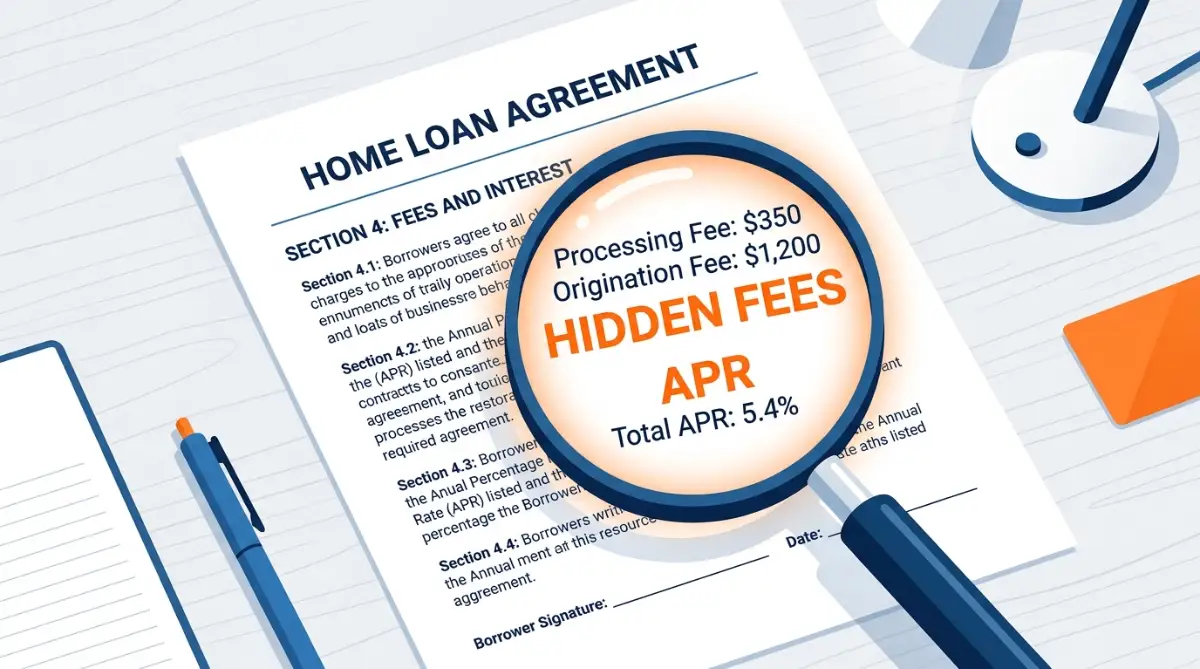
Lenders often highlight a low interest rate in big, bold letters. However, the interest rate is not the total cost of the loan.
The number you really need to watch is the APR (Annual Percentage Rate). The APR includes the interest rate plus any fees, like origination fees or processing costs.
A loan with a 5% interest rate and a 3% fee might actually be more expensive than a 7% loan with no fees. Always ask for the total APR to see the real cost.
If you don't check this, you might end up paying hundreds of dollars in hidden fees on the very first day. It is like buying a car and finding out there is a "delivery fee" that costs as much as the engine.
The Danger of Multiple Applications in a Short Time
When people get a rejection, they often panic and apply to three or four other lenders the same day. They hope that someone, somewhere, will say yes.
This is a massive red flag for banks and credit bureaus. It looks like you are in a financial crisis and desperate for cash.
Every hard inquiry on your credit report makes you look more risky. If a lender sees five inquiries in one week, they will almost always say no.
If you get rejected, stop everything. Find out why you were denied, fix the problem, and wait at least 30 to 60 days before trying again.
A Tale of Two Borrowers (Why APR Matters)
Let’s look at a quick example of how people lose money by not checking the fine print:
- Borrower A: Gets a loan with 6% Interest but has a $500 setup fee.
- Borrower B: Gets a loan with 7.5% Interest and $0 fees.
Over three years, Borrower B actually pays less. Don’t get blinded by the "Interest Rate" headline. Always look for the total cost, which is the APR.
Falling for the "Easy Money" No-Credit-Check Trap
You will see ads for loans that require "no credit check" or "guaranteed approval." These are almost always predatory loans with massive interest rates.
Sometimes these loans have rates as high as 300% or 400% when you calculate the APR. This can turn a $500 loan into a $2,000 debt very quickly.
These lenders don't care if you can afford the loan. They make money when you fail to pay and have to take out another loan to cover the first one.
Always stay away from these "fast cash" offers. It is much better to wait and build your credit than to get trapped in a cycle of high-interest debt.
Forgetting to Read the Fine Print on Prepayment
Some lenders actually punish you for being responsible and paying off your loan early. They charge something called a "prepayment penalty."
They do this because they want to collect every penny of interest they planned for. If you pay early, they lose money.
Always look for a loan that has "no prepayment penalties." This gives you the freedom to pay more whenever you have extra cash.
If you get a bonus or a tax refund, you should be able to put it toward your loan without being fined. Check the contract carefully before you sign your name.
Taking Charge of Your Financial Story Today
Applying for a personal loan is a big step, but it doesn't have to be a scary one. You now have the knowledge to avoid the traps that trip up most people.
Think of your financial life as a story that you are writing every day. Each choice you make about borrowing and spending is a new chapter in that story.
By being patient and checking your credit, you are setting yourself up for success. You are moving from being someone who "needs" a loan to someone who "chooses" the best financial tool.
Don't let a past rejection stop you from trying again with a better plan. Every person who is wealthy today started by learning how to handle small amounts of money correctly.
You have the power to change your credit score, lower your debts, and build a bright future. It starts with one smart decision today, like checking your credit report or making a better budget.
Believe in your ability to manage your money well. Use the tips you learned here to walk into any bank or online lender with total confidence.
Your financial freedom is waiting for you. Take the first step, avoid the common mistakes, and watch your life transform for the better.
Start small with just one deep breath today, and you’ll be amazed at how much stronger you really are.
Take one small step today, like checking your credit report for errors, and start building the bright future you truly deserve.
Disclaimer: This article is for informational purposes only and does not constitute financial, legal, or professional advice. Loan approval depends on individual circumstances and lender policies. Always consult with a certified financial advisor before making significant financial decisions.