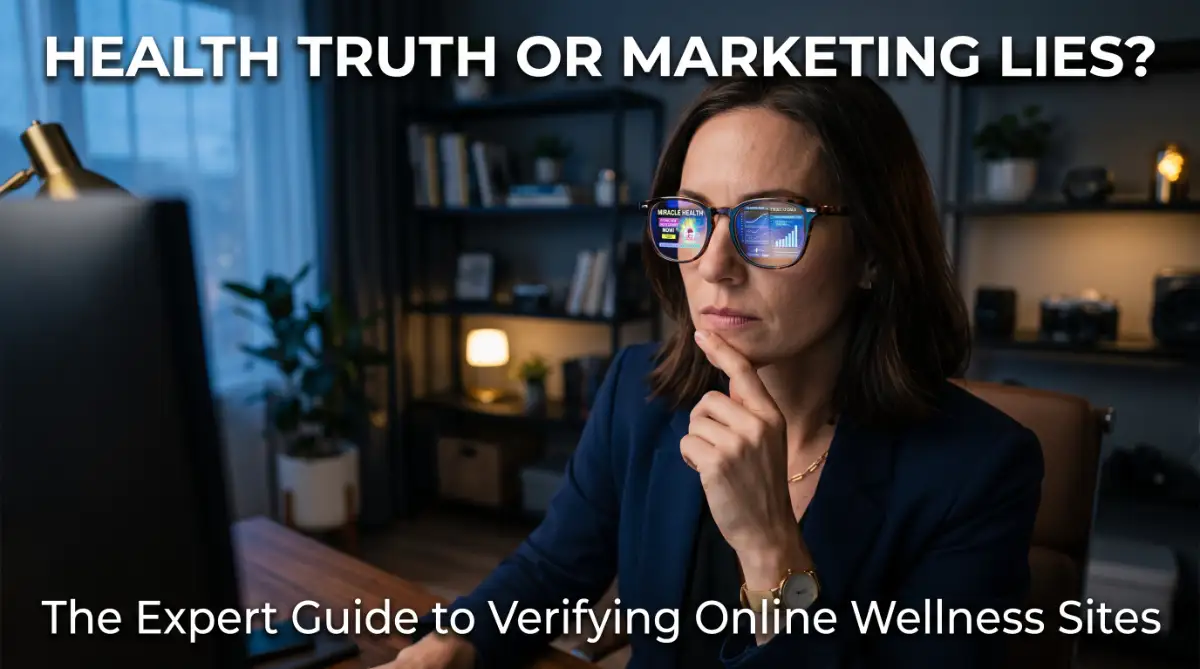
The Hidden Anxiety of the Search Bar Diagnosis
We have all been in this situation before. You feel a strange flutter in your chest or a dull ache in your back that won't go away. Your first instinct is to grab your phone and type those symptoms into a search engine.
Within seconds, you are looking at a website that tells you your minor symptom is a sign of something terrifying. Your heart starts to beat faster, and your palms get sweaty. This is the reality of searching for health advice in a world filled with noisy information.
It is exhausting to navigate a sea of scary headlines and "miracle" cures. You just want to know if you are okay, but the internet often makes you feel much worse. This struggle to find simple, honest truth is something millions of people deal with every single day.
I remember googling a weird symptom at 2 AM and ending up convinced I had something terrifying, when it turned out to be nothing serious at all.
My heart was racing just from reading a random blog post written by someone with zero medical background. That night taught me I needed a real system for checking who I was actually trusting online.
Why We Get Lost in a Sea of Wellness Misinformation
Finding the right health solution online feels like a puzzle with missing pieces. Even when we try our best, we often end up on the wrong pages. Here is why the search for truth is so difficult:
- Marketing Over Substance: Many websites hire amazing designers to make their pages look beautiful, even if the advice they give is completely wrong.
- The "Clickbait" Trap: Websites often use scary or exciting headlines just to get you to click so they can earn money from advertisements.
- Algorithm Confusion: Search engines sometimes show you what is popular or catchy instead of what is medically accurate or safe.
- Personal Bias: We often look for answers that fit what we already believe, which leads us to trust websites that tell us what we want to hear.
How Bad Advice Breaks Your Confidence and Peace
Following the wrong wellness path does more than just waste your time. It can actually hurt your mental and emotional state in a way that is hard to fix.
- Constant Worry: Reading unverified medical stories can lead to "health anxiety," making you feel like every small change in your body is a disaster.
- Wasted Resources: People spend a lot of money on supplements or programs that don't work because a "wellness guru" promised they were necessary.
- Broken Trust: When you follow advice that fails, you start to lose trust in all health information, even the stuff that could actually help you.
- Decision Paralysis: With so many conflicting voices, you might end up doing nothing at all because you are too afraid to make the wrong choice.
The Harsh Reality of the Digital Health Boom
The wellness industry is a billion-dollar business. This means that for many websites, your health is not the main priority. Their main goal is often to sell you a product or keep you clicking on their pages.
This is a hard truth to accept. We want to believe that everyone writing about health wants to help us. But in reality, many sites are run by people who have no medical training at all.
They use clever words and bright colors to hide the fact that they are just guessing. They take a tiny bit of science and stretch it until it becomes a lie. If you don't know how to see through these tricks, you are basically a target for their marketing.
The internet has changed how we look at our bodies. It has given us a lot of power, but it has also given us a lot of danger. You need to learn how to be a "health detective" so you can protect yourself and your family.
Step 1: Identifying the Face and Name Behind the Content
The first thing you should do when you land on a health page is look for the author. A website that hides its writers is usually a website that doesn't want to be held responsible for what it says.
Look for Professional Credentials: I always look for titles like M.D., R.D., or Ph.D. near the author's name. This tells you that the person has spent years in a classroom learning how the body actually works.
Check the "Medical Review" Label: Many great websites use professional writers, but they have their articles checked by doctors. Look for a small note that says "Medically Reviewed by [Doctor's Name]." This is a sign that the site cares about accuracy.
The Google Test for Authors: Take the writer's name and put it into a search engine. Do they have a real LinkedIn profile? Do they work at a university or a hospital? If they don't exist outside of that one blog, be very careful.
Curious how to run this credibility check yourself in under two minutes? Here's exactly how it's done.
Step 2: Following the Breadcrumbs of Scientific Proof
A reliable health website will never ask you to just "take their word for it." They will show you exactly where they got their information. This is how science works—it is open and honest.
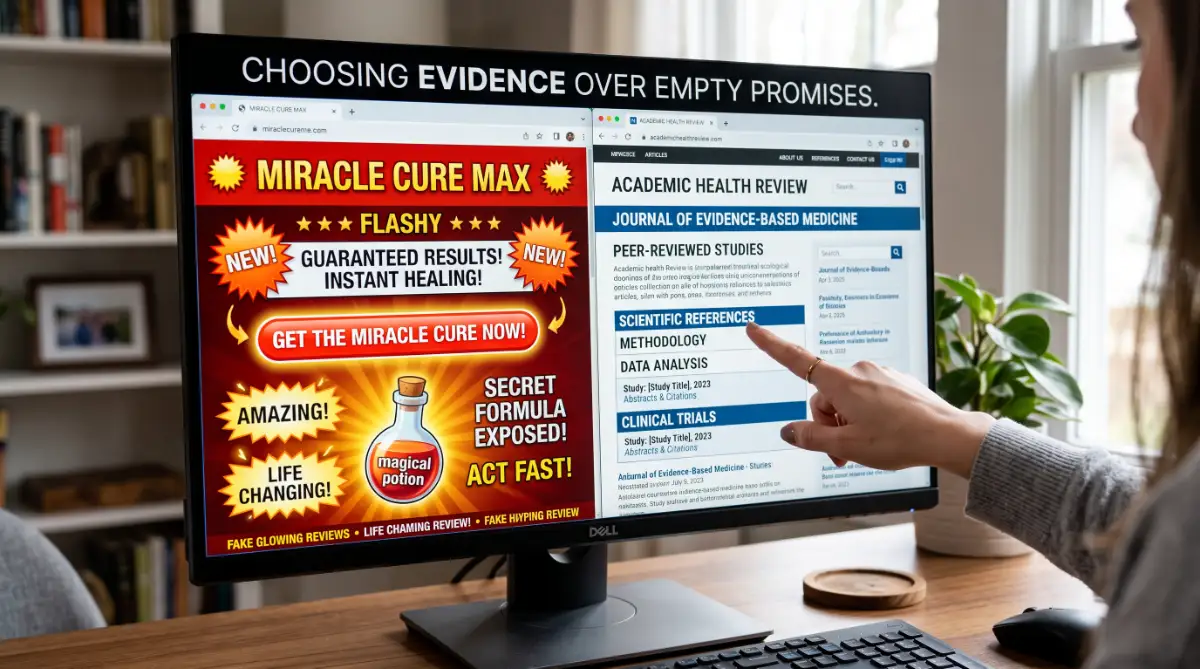
Look for Active Citations: High-quality sites will include links to peer-reviewed studies or medical journals. If you see a claim like "studies show that coffee prevents aging," there should be a link to that specific study.
The Source of the Study: Check if the links go to trusted places like the National Institutes of Health (NIH) or famous medical schools. If the links just go to another blog or a store selling coffee, that is not real proof.
Watch Out for "Cherry Picking": Sometimes a site will take one tiny study that was done on three mice and act like it applies to all humans. Real experts look at the whole "body of evidence," not just one small, weird result.
Pro tip I learned the hard way: I once followed a supplement recommendation because the site linked to a "study," only to realize later it was a tiny trial with a handful of participants, not the large-scale research I assumed.
Now I always click through to the actual source before I trust any health claim, no matter how confident the writing sounds.
Step 3: Decoding the Commercial Motive and Bias
Every website has a reason for existing. Some exist to help the public, while others exist to make a profit. You need to figure out which one you are looking at.
Check for Direct Product Sales: If an article tells you that a certain vitamin is "the only way to stay healthy" and then gives you a link to buy that exact vitamin, they are biased. Their goal is to sell, not to teach.
The "Miracle" Language Warning: Science is usually quite boring and careful. Real doctors say things like "this may help" or "further research is needed." If a site uses words like "secret," "miracle," "unbelievable," or "instant," they are likely lying.
Who Pays for the Site?: Look at the very bottom of the page in the footer. Does it say the site is funded by a pharmaceutical company or a supplement brand?
Knowing who pays the bills will tell you if the information is being twisted to favor a specific product.
Why "Common Knowledge" Is Often Wrong
We often trust websites that repeat things we have heard all our lives. This is a mistake. Just because a million people believe something doesn't make it a medical fact.
Think about the old idea that you should wait an hour after eating before you swim. For a long time, everyone thought this was true. But if you look at modern medical resources, they will tell you there is no science to back that up.
A reliable website stays up to date with new discoveries. It isn't afraid to tell you that an old "health tip" was actually wrong. This honesty is a major sign of a site you can trust with your well-being.
The Power of the Domain Ending
While it isn't a perfect rule, the end of a website's address can tell you a lot about its purpose. It is a quick way to filter your search results.
Trust .gov and .edu sites: These are almost always the safest places to get info. Government agencies and universities have very strict rules about what they can publish. They are focused on public health, not profit.
Be careful with .com and .net sites: These are commercial sites. Some are amazing (like Mayo Clinic), but others are just businesses. You have to use the other steps we talked about to verify them.
Check the "About Us" page: A reliable site will clearly state who they are, where their office is, and who is on their medical board. If the "About Us" page is vague or missing, you should move on to a different resource.
Trusting Your Instincts and Taking a Breath
At the end of the day, your brain is a very good "lie detector." If a health claim sounds too good to be true, it probably is. If a website makes you feel panicked or pressured to buy something right now, it is not a good resource.
I always suggest taking a deep breath before you start reading. Remember that one blog post is not a replacement for a real conversation with a doctor.
The goal of online research should be to prepare you for that conversation, not to replace it.
You are the boss of your own body. By learning these steps, you are taking back control from the marketers and the fake gurus.
You are choosing to value truth over catchy headlines, and that is the best thing you can do for your long-term health.
Investigating the Money Trail Behind the Health Advice
When you read a health article that sounds a bit too perfect, you have to ask yourself one question. Who is paying for this information? This is the gold standard for expert verification.
If a website writes about the amazing benefits of a specific berry, check their shop. If they sell that berry in powder form, their advice is biased. They are not giving you health tips; they are giving you a sales pitch.
Professional health resources should separate their editorial content from their advertisements. You can often find this in their "Disclosure" or "Funding" section. True experts are honest about where their money comes from so you can make your own choice.
I always look for a "Conflict of Interest" statement in scientific papers linked by a website. If a study about heart health was paid for by a fast-food company, I take those results with a grain of salt.
For more on making smart choices, you might find it helpful to learn about mastering your health insurance deductible to see how professional systems handle health costs.
Decoding the Language of Science vs. Marketing
Marketers use emotional words to bypass your logic. They want you to feel excited or scared. Scientists and real medical writers do the exact opposite.
They use neutral and careful language. You will see phrases like "current evidence suggests" or "while this shows promise, more human trials are needed." This might feel less exciting to read, but it is much safer for your body.
If an article uses words like "unlimited energy," "fat-burning secret," or "instant cure," it is almost certainly a marketing trap. Real biology does not work in "instants" or "secrets." It is slow, steady, and very complex.
A great way to stay grounded is to master your mind and learn how to stay calm and think clearly under pressure. This mental strength helps you pause before you hit "buy" on a product that makes too many big promises.
How to Verify the "Medical Consensus"
Science is not about one person finding a magic answer in a basement. It is about thousands of smart people checking each other's work. This is what we call the "Medical Consensus."
When you find a new health tip, don't just look at one site. Go to three or four highly trusted sources like the NIH or Harvard Health Publishing. See if they all say roughly the same thing.
If one blog says you should only eat purple vegetables and everyone else says a balanced diet is best, trust the group. The "lone genius" who knows something all the doctors are hiding is a common character in fake health news.
This is a great habit to build for long-term health literacy. It keeps you from jumping on every new trend that comes across your social media feed. Consistency in your research is what leads to long-term success.
Building a Professional Strategy for Information Sorting
You don't need to be a doctor to think like one when you read online. You just need a better system for sorting the "junk" from the "gems." This is a skill you can practice every day.
I suggest creating a "Trusted List" of websites in your browser bookmarks. These should be sites that have proven their accuracy over time. When you have a question, go to those sites first instead of using a general search engine.
This saves you time and protects your mental peace. You won't have to wade through scary headlines or confusing ads. You will get the facts you need from people who have earned your trust.
Learning how to navigate complex info is similar to choosing the right health insurance coverage for your family needs. Both require you to look past the shiny surface and check the actual details that matter for your future.

The Trap of the "Social Media Doctor"
We often fall into the trap of trusting someone just because they have a high-quality camera and a lot of followers. These people often look very healthy and happy. They use their appearance to sell you their ideas.
However, having six-pack abs does not mean someone understands the endocrine system or heart health.
Many influencers are paid to promote "cleanses" or "detoxes" that have zero scientific backing. In some cases, these products can even be dangerous for your kidneys or liver.
Always remember that an influencer’s primary job is to keep you watching. A doctor’s primary job is to keep you healthy. These two goals are not always the same.
Before you follow a trend you saw on a video app, ask for the data. If they can't show you a peer-reviewed study, it’s just an opinion. And in the world of health, opinions can be very expensive mistakes.
Confusing Correlation with Causation
This is a very common mistake that even well-meaning writers make. It sounds complicated, but it is actually quite simple to understand with an example.
Imagine a study says, "People who wear expensive watches have fewer heart attacks." Does the watch protect the heart? Of course not. The watch is just a sign that the person is wealthy and likely has better food and healthcare.
Fake wellness sites love to use these kinds of stats. They might say, "Eating this specific nut is linked to longer life." But maybe the people who eat those nuts also exercise more and don't smoke.
A reliable website will explain these details to you. They won't act like one food or one habit is a magic shield. They will look at the whole lifestyle, which is much more honest.
Ignoring the Individual Nature of Health
Many people search for "The Best Diet" or "The Best Supplement." The big mistake here is thinking that what works for a 20-year-old athlete will work for a 60-year-old grandmother.
Health is deeply personal. Your genetics, your history, and your environment change how your body reacts to things. A website that says their plan is "perfect for everyone" is ignoring basic biology.
Professional resources will always include a warning. They will say, "Consult your doctor before starting this." They will list "Contraindications," which are reasons why certain people should stay away from a treatment.
If a site doesn't mention any risks or downsides, they are not being truthful. Every choice in health has a balance of risks and rewards. You deserve to know both sides.
Relying Solely on "Natural" as a Sign of Safety
There is a huge myth that "natural" always means "safe." This is one of the most successful marketing lies in the history of the wellness industry.
Remember, lead is natural. Poison ivy is natural. Many natural herbs can have powerful effects on the body and can interact badly with regular medicine.
If a website tells you to stop taking your prescribed medicine and switch to a "natural" tea, you should be very worried. This kind of advice can lead to serious health crises.
A trustworthy site will respect both modern medicine and natural options. They will show how they can work together safely. They won't treat "natural" as a magic word that makes all risks disappear.
Forgetting to Check the Date of the Research
I see people sharing health articles that are over ten years old as if they were brand new. In medical science, ten years is an eternity. We learn new things every single day.
A study from a decade ago might have been based on technology that is now outdated. Or perhaps a larger study was done later that proved the first one was wrong.
Always look for the most recent data. If a website is still citing a study from a long time ago and ignoring more recent ones, they are not giving you the full picture.
This is part of being an active researcher. You want the most modern, accurate map of the health world so you don't get lost in old, incorrect theories.
Taking Action Toward a Healthier Digital Life
You have now learned the advanced secrets of verifying health information. You know how to look for the money trail, how to decode marketing language, and how to spot common traps.
The most important thing you can do now is start using these tools. Don't let yourself be a passive reader. Be an active investigator.
Your health is too important to leave in the hands of a stranger with a shiny website. You have the power to find the truth. It just takes a little bit of patience and the right questions.
I encourage you to take one health topic you are curious about today. Go find three different sources for it. Use the checklist we discussed. See which sites pass the test and which ones fail.
A Positive Word on Your Wellness Journey
It might feel overwhelming at first to check every site you read. But very quickly, it will become a habit. You will start to see the patterns of fake news and marketing hype instantly.
This process will actually lower your stress. Instead of worrying about every new "health threat" you read about, you will know how to stay calm. You will know how to find the real facts and ignore the noise.
You are doing a great job by educating yourself. Most people never take this step. By reading this, you are already ahead of the crowd.
Keep your curiosity high and your skepticism sharp. You have everything you need to navigate the online wellness world safely. Here is to your health, your clarity, and your bright, informed future.
Once I started checking author credentials and looking for real citations, I felt so much calmer reading health content online.
I stopped panicking over every scary headline and started trusting my own judgment again. Try this checklist on the very next health article you read, and you'll feel that same sense of control.
Disclaimer: The content provided on this website is for informational and educational purposes only. It is not intended to be a substitute for professional medical advice, diagnosis, or treatment. Always seek the advice of your physician or other qualified health provider with any questions you may have regarding a medical condition. Never disregard professional medical advice or delay in seeking it because of something you have read on this website.
