Why Starting a Side Hustle With Zero Savings Feels Impossible (And Why It Isn't)
Let me take you back to a night I still remember clearly. I was sitting on my bed with my phone, checking my balance for the third time that day. Every "easy side hustle" post I read started the same way: buy this, subscribe to that, invest first.
I felt stuck. I had the time and the energy, but I didn't have the cash they kept asking for. So I did what many of us do and told myself I would start someday, when things got better.
If you're reading this, you probably know that feeling. You see other people talking about extra income while you're counting what's left until payday. It's not laziness, and it's not a lack of ambition.
The stress shows up in small ways. You skip plans with friends because you can't spend. You lie awake doing math in your head, and you feel guilty every time you buy something that isn't a bill.
Then the advice makes it worse. Everyone says to "just invest in yourself," as if spare money is lying around. That kind of advice makes you feel like the door to earning more is locked from the start.
Here's what I wish someone had told me back then. The door isn't locked, because many side hustles run on skills and time instead of cash. You don't need a big budget to begin, you need a clear plan and a small first step.
How to Start a Side Hustle With No Money: A Simple Plan You Can Begin Tonight
Starting a side hustle with no money is less about luck and more about order. When you do things in the right sequence, you avoid wasted effort and you protect the little time you have.
Think of it like cooking dinner with what's already in your fridge. You don't go shopping first, you look at what you have and build a meal around it. The same idea works here.
Step One: Count What You Already Own (It's More Than You Think)
Most beginners say, "I have nothing to offer." That's rarely true.
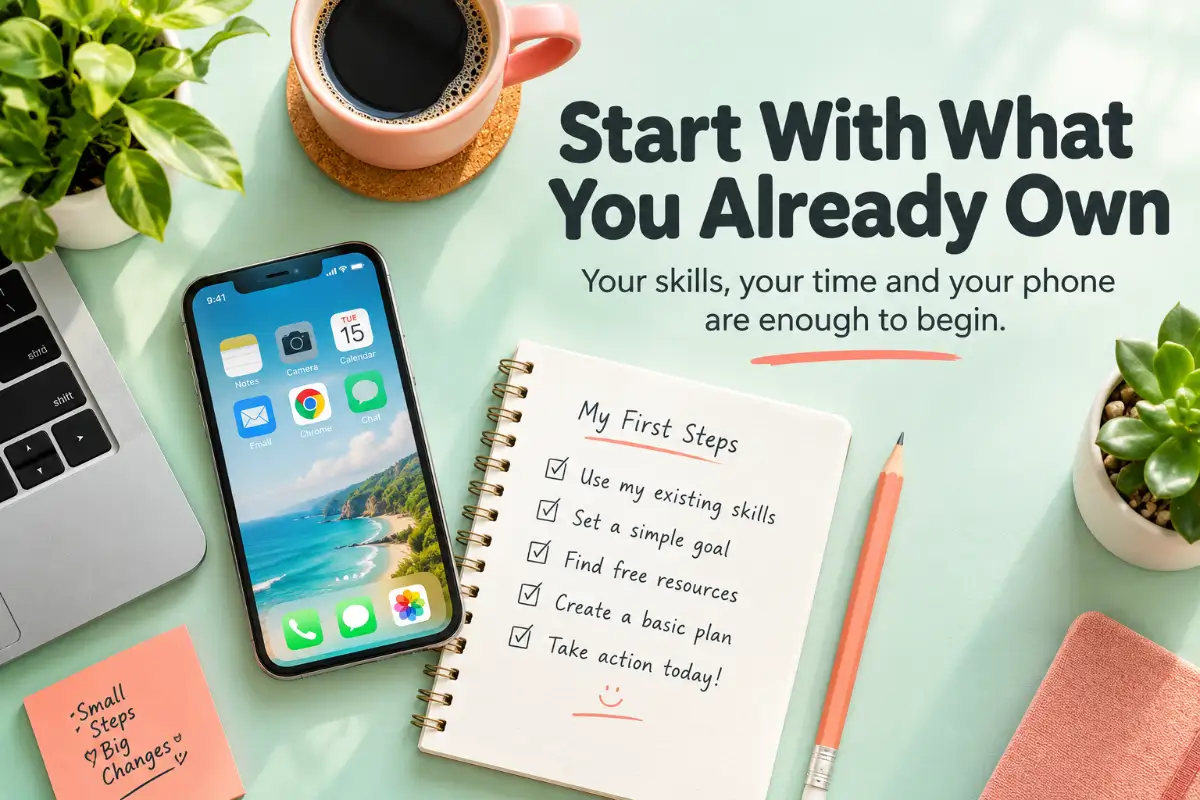
Grab a notebook and write down these five things:
- Skills: Anything people ask you for help with, like fixing a resume, planning a trip or editing a photo.
- Time: The real hours you can protect each week, even if it's only a few.
- Tools: A phone, a laptop, a library card or free Wi-Fi.
- Knowledge: A subject you know well, from budgeting to video games.
- People: Friends, coworkers and neighbors who might become your first customers.
Here's a quick real-life example. Picture a neighbor who always helps friends tidy up their resumes. She never thought of it as a skill, but a few job seekers would gladly pay for that help.
Once the list is on paper, circle the one skill you enjoy the most. That's your starting point, and it won't cost you a cent.
Step Two: Decide Where Your Time Fits Best
Your schedule decides your side hustle more than your talent does. A person with a tight work shift needs a different plan than a student with free afternoons.
Ask yourself two simple questions. How many hours can I give each week? And do I prefer working on my laptop or being out and about?
If You Prefer to Work Online
Online work gives you a wider pool of customers, since people from any city can hire you. It also lets you work late at night or early in the morning.
The trade-off is competition. You'll need a clear message about who you help, so people can find you fast.
If You Prefer Local Work
Local work often pays sooner, because people already trust faces they know. It also needs less tech and fewer profile setups.
The trade-off is your calendar. You'll have to show up at set times, which can be hard around a busy job.
Myth vs Reality: What Free Side Hustles Really Look Like
A lot of beginners quit early because they believe a few common myths. Let's clear them up.
- Myth: I need a website before I can start.
- Reality: You can begin with a simple free profile and two or three samples.
- Myth: I need years of experience.
- Reality: Many first clients care more about reliability and clear communication than a long resume.
- Myth: I'll replace my paycheck in a week.
- Reality: Most people earn small amounts first, then grow as reviews and referrals build up.
- Myth: Everything online is a scam.
- Reality: Plenty of honest work exists, but you should never pay to get a job or share bank logins with a stranger.
Believing the reality side of this list will save you a lot of stress. It also helps you set expectations you can actually meet.
Five Beginner-Friendly Ideas You Can Test for Free
You don't need to try all of these. Pick the one that matches your answers from Steps One and Two.
| Idea | What You Need | Time to First Payment | Main Challenge |
|---|---|---|---|
| Freelance writing | Laptop and a few samples | A few days to a few weeks | Standing out in a crowded field |
| Virtual assistant tasks | Laptop and reliable habits | A few days to a few weeks | Clients with unclear tasks |
| Social media help for local shops | Phone and an eye for detail | One to three weeks | Showing results to owners |
| Online tutoring | A subject you know well | One to two weeks | Fixed lesson times |
| Proofreading | Careful eyes and patience | A few days to a few weeks | Slow, detail-heavy work |
The times above are rough guides, not promises. Your skills, your niche and the effort you put in will change the result.
Freelance Writing
Businesses and bloggers always need new words for websites, emails and product pages. You don't need a degree to begin, only a few clean writing samples.
Write two short pieces on topics you know, then offer to write for small businesses that have outdated websites. Your first jobs will probably be small, and that's fine. For more help, see this guide on starting freelancing with no experience.
Virtual Assistant Tasks
Busy owners often get buried under emails, scheduling and simple data entry. If you're organized, you can take that load off their shoulders.
Start by listing three tasks you can do without training. Then offer them in a short message, with clear hours and a clear price.
Social Media Help for Local Shops
Many local cafes, salons and gyms know they should post online, but they don't have time. You can plan posts, write captions and reply to comments for them.
Practice on a friend's account first and keep screenshots of your work. That gives you proof to show the next owner you contact.
Online Tutoring
If you're strong in a school subject, a language or a software tool, someone is looking for a teacher. Parents and adult learners both search for patient helpers.
Offer a short trial lesson so the student can see your style. A good first lesson often turns into regular weekly sessions.
Proofreading
Writers, students and small businesses all want clean text without spelling and grammar mistakes. This idea suits people who notice small details.
Practice by fixing sample documents, then offer your help to bloggers and students you know. Reliable work earns repeat requests quickly.
Step Three: Build Proof Without Spending a Cent
Customers don't trust promises, they trust proof. The good news is that proof is free to create.
Open a free document and add two or three samples of your work, and use this guide on building a portfolio that attracts paying clients if you want extra help. If you offer tutoring, write a short sample lesson plan, and if you offer writing, add two short articles.
Want to see how beginners put a free profile together in one sitting? Watch this quick walkthrough before you move on, because it will make the next step feel much easier.
Next, write one clear sentence about who you help and how. For example: "I help small shop owners plan a week of social posts so they can save time."
Here's a mistake I made early on, and I want you to skip it. I spent almost a whole week choosing a logo and a color palette before I had a single customer. My first real message did far more for me than any logo, so send the messages first and polish later.
Why Small Wins Matter More Than You Think
Researchers who study motivation have found that seeing progress keeps people going. That's why one finished sample or one friendly message matters.
Each small win tells your brain that this is working. That feeling is what gets you through the slow first weeks.
A Quick Note on Income and Taxes
If you live in the United States, income from side work is generally taxable. Keep simple records from your very first payment, and check the official IRS page on self-employment tax for the rules that apply to you.
Doing this early saves you from stress later. It also makes your side hustle feel like a real project instead of a guess.
Now you have a skill, a plan and proof of your work. In the next part, we'll look at local options, a simple first-week plan and the warning signs of scams, so you can move forward safely.
From Samples to Your First Paycheck: The Rest of the Plan
You now have a skill, a schedule and a few samples that prove you can do the work. Next comes the part that feels a little scary, which is getting a real person to say yes.
Step Four: Send Ten Friendly Messages This Week
Don't wait until you feel ready, because that day rarely comes. Set one simple rule: *contact ten people before you decide your idea isn't working*.
Think of it like knocking on doors. Most doors stay closed, but one or two open, and that is all you need to start.
What to Say in Your First Message
Keep it short, warm and specific. Here's an example you can adjust: "Hi Sam, I help small shops plan a week of social media posts. I made a free sample for your cafe, would you like to see it?"
Notice what this message does. It names who you help, it shows you did some homework, and it asks a small question that's easy to answer.
Where to Look Close to Home
Local work often pays sooner because people already trust faces they know. Try neighbors, former coworkers, small shop owners, community groups and parent networks.
If you picked virtual assistant work, this step-by-step virtual assistant business blueprint can help you shape your first offer. Online, you can also reply to small job posts on freelance sites, but read every post carefully before you answer.
Step Five: Do the First Job Small and Do It Well
Your first paid job is like a test drive. The client is checking how you communicate, and you're checking whether you like the work.
Pick a small, clearly defined task and agree on the price in writing. Then deliver a little earlier than promised.
Why You Shouldn't Work for Free Forever
A free sample is fine, but free work week after week teaches people that your time has no value. Charge a modest starter price instead, even if it's small.
Picture a student who tutors a neighbor's child for a low fee. Two good lessons later, the parent tells three friends, and the student has a waiting list without spending a cent on ads.
Ask for a Review or a Referral
At the end of the job, ask two things: "Was everything clear?" and "Who else might need this?" Most first customers are happy to answer.
Save kind words in a notes file. Those lines become the proof you show the next client.
Step Six: Track Every Dollar and Every Hour
This step sounds boring, yet it protects you from a very common surprise. A *simple spreadsheet* can show you your real hourly rate.
Create five columns: date, client, task, hours and amount. Add one more for any money you spent.
Here's why it matters. If a job pays $40 and takes five hours, you earned $8 an hour, and that tells you to raise your price or work faster next time.
Tracking also makes tax time much easier. If your income swings from week to week, learn how to build a realistic budget with irregular income so a slow week doesn't catch you off guard.
Step Seven: Hold a 30 Day Review, Then Keep, Tweak or Switch
After about a month, sit down with your spreadsheet and ask yourself three things. Did I enjoy this, did anyone pay me, and could I do more of it?
If the answers are yes, keep going and raise your price a little. If people aren't replying, *tweak your message* before you quit. And if you truly dislike the work, switch to another idea from earlier in this guide without any guilt.
How to Keep Your Side Hustle Growing Without Burning Out
Starting is one skill and sticking with it is another. These habits help you stay steady over the long run.
Pick a Niche That Makes You Easy to Remember
"I'm a tutor" is easy to forget. "I help adults learn practical English for work" is easy to remember and easy to refer to a friend.
Narrow offers feel more expert, and experts can charge more over time. You can always widen your offer later.
Raise Your Prices in Small Steps
Once you have a few happy clients, raise your rate for **new** customers first. Small, regular increases feel fair and keep you from underpaying yourself for years.
Protect Your Energy and Your Day Job
Check your employment contract or workplace policy before you take on side work, because some employers have rules about outside jobs. Then choose a fixed weekly rhythm, like three evenings and one weekend morning.
Think of your side hustle like a garden. A little water every day beats a big flood once a month.
Use Free Guidance When You Get Stuck
You don't have to figure everything out alone. SCORE connects small business owners with volunteer mentors, and it's a good place to ask questions about pricing, planning and finding customers.
Plan for the Day It Starts to Grow
If your side hustle keeps growing, you may want to learn about legal setups. The SBA explains the basics of choosing a business structure in plain language.
When you're ready to set a bigger target, this guide on building toward an extra $1,000 a month with a side hustle shows how to think about it step by step.
Quick Do's and Don'ts
- **Do** answer messages within a day, since fast replies build trust.
- **Do** keep copies of your samples, invoices and reviews.
- **Don't** take on five clients at once when you're still learning.
- **Don't** spend money on tools until a paying client asks for something you truly can't do for free.

The Costly Traps That Quietly Kill New Side Hustles
Let me paint a picture. Someone is excited, they see an ad that says "earn big with no experience," and they pay for a starter kit. A week later, the kit is a few generic files, the money is gone and their confidence takes a hit.
That story is more common than most people admit. Here are the traps that cause the most damage, and what each one can cost you.
Paying Money to "Get Hired"
A real client pays you, not the other way around. If someone asks for a fee to unlock work, a training bundle or a "starter package," walk away.
*What it costs you:* your small savings, plus the motivation you need for the real thing. The FTC explains how common task scams work, and it's worth a quick read before you reply to any job offer.
Sharing Private Details Too Early
Never share bank logins, passwords or ID photos with a stranger who offers you work. Be careful with anyone who sends a check and asks you to send part of it back.
*What it costs you:* possible stolen money and a long, stressful cleanup. For more ways to spot risky offers, read how to protect your money from fake loan and insurance offers.
Trying Five Ideas at the Same Time
Jumping between ideas feels productive, yet nothing gets enough attention to work. Pick one idea and give it at least a full month.
*What it costs you:* weeks of effort with no results to learn from.
Pricing Yourself Too Low, Then Staying There
A low starter price is smart for your first job. A low price forever is a quiet trap that leaves you tired and underpaid.
*What it costs you:* the energy you need to keep going.
Ignoring Taxes Until Spring
Side income is often taxable, and surprises at tax time hurt. Keep records from your first payment and set a portion of each payment aside.
*What it costs you:* an unexpected bill when money is already tight.
Quitting in Week Two
Most side hustles feel slow at the start. Replies take time, and your first sale may arrive after your tenth message, not your second.
*What it costs you:* the results that were waiting just beyond the point where you stopped.
Quick Answers to What Beginners Ask Most
What is the best side hustle to start with no money?
The best one is the idea that matches a skill you already have and the hours you can truly spare. For many beginners, that means services like writing, tutoring or virtual assistant work, since they only need a phone or laptop.
Can you make $1,000 a week without a job?
It's possible for some people, but it's not typical for beginners, and it usually takes weeks or months to build up. Be very careful with anyone who promises that amount quickly, because big promises are a classic scam sign.
Is it realistic to make $500 in one day without a job?
Sometimes a one-time burst happens, like selling things you already own or taking a few local gigs. It's not a steady plan, so treat it as a bonus and not something you can count on every day.
Do I have to pay taxes on side hustle income?
In many places, yes, even when the amount is small. Rules depend on where you live, so check your local tax office and consider talking to a tax professional.
How long does it take to get paid the first time?
It can take a few days or a few weeks, depending on your idea and how many people you contact. Sending your ten messages early is the fastest way to shorten that wait.
You're Closer to Your First Paid Job Than You Think
Let's pull it together. You don't need savings to begin a side hustle, you need a skill, a small plan and the courage to send a few messages.
Work through the steps in order: count what you own, choose where your time fits, build proof, message ten people, do one small job well, track your numbers and review after a month. Each step is small, and small steps add up.
Your Action Plan for Tomorrow
- Pick one skill from your list.
- Write one sentence about who you help.
- Send your first three messages before the day ends.
When I finally sent my first message, nothing dramatic happened, but that tiny step proved to me that starting small beats waiting for the perfect moment. You can do the same thing today, with the phone already in your hand. Send that first message and let the rest follow.
Disclaimer: This article is for educational and informational purposes only and is not financial, tax, legal or professional advice. Income from any side hustle varies by skill, effort, location and market demand, and no results are guaranteed. Always check local rules and speak with a qualified professional before making financial or tax decisions.