The Burning Truth About Your Laptop's Heat
I remember sitting at my desk last summer, trying to finish a project while my laptop felt like a literal pizza oven on my lap. The fan was screaming so loud I couldn't even hear my own music, and I was terrified my expensive machine was about to melt into a puddle.
I felt so frustrated because I didn't know if I was accidentally killing my battery every time I plugged it in.
You plug in your laptop to get some work done or watch a movie. Within minutes, the keyboard feels like a hot frying pan. You hear the internal fan spinning so fast it sounds like a jet engine taking off.
This isn't just an annoying problem. It is a sign that your expensive device is struggling to survive. When your laptop gets this hot, it’s a cry for help.
You probably worry that the battery might swell or the internal parts might melt. These are real fears. Heat is the silent killer of all electronics.
If your laptop stays hot for too long, it will slow down. You will notice lag, apps crashing, and the screen freezing. It turns a productive day into a total nightmare.
Why Common Advice Often Fails You
Many people tell you to just "turn it off" or "buy a new one." But that doesn't solve the root of the problem. Here is why the usual tips don't always work:
- Most people think a cooling pad is a magic fix, but if your vents are clogged, a pad does nothing.
- Blowing air into the vents with your mouth can actually push moisture inside, causing more harm.
- Generic advice tells you to "lower brightness," but that won't stop a faulty charger from cooking your battery.
- Following "internet hacks" like putting your laptop in the fridge is a fast way to kill it with condensation.
- Using cheap, third-party chargers might save you money now but can fry your motherboard later.
How Overheating Steals Your Peace of Mind
Living with a device that overheats is stressful. You can't focus on your work because you are constantly checking the temperature. It ruins your flow and makes you lose trust in your gear.
- You feel anxious every time you plug the charger in, wondering if today is the day it breaks.
- The constant loud fan noise makes it hard to concentrate or enjoy a quiet workspace.
- You lose confidence in your laptop's ability to handle big tasks like video calls or gaming.
- The fear of losing your unsaved work due to a heat-related shutdown stays in the back of your mind.
- It feels like a waste of money when a premium laptop performs like an old, cheap machine.
A Professional Look at the Heat Crisis
Let’s look at this like an expert. When you charge your laptop, the battery creates chemical energy. This process naturally makes a little heat.
However, your laptop has to manage two heat sources at once: the battery and the processor. If the heat can’t escape, it builds up. This is called thermal throttling.
The system slows itself down to prevent a fire or permanent damage. This is why your mouse cursor starts to jump and your videos start to buffer. We need to fix the airflow and the power flow to get your speed back.

Your Blueprint for a Cooler, Faster Laptop
Now, let's get into the actual steps to fix this. You don't need to be a tech genius to follow these. We will start with the most common issues and move to the more technical ones.
1. Master the Surface Strategy
The biggest mistake people make is where they put their laptop. If you are charging your laptop on a bed, a pillow, or a couch, you are suffocating it.
Laptops pull in cool air from the bottom. Soft surfaces block those vents completely. The heat stays trapped inside the plastic shell.
The Fix: Always use a hard, flat surface like a wooden desk or a glass table. This allows the small rubber feet on the bottom of the laptop to do their job.
They create a tiny gap for air to move. If you must work from bed, use a flat "lap desk." Even a large hardcover book is better than a soft blanket.
2. Audit Your Charging Equipment
Not all chargers are created equal. If you are using a charger that didn't come in the box, it might be the reason for the heat.
Cheap chargers often have poor "voltage regulation." They might be pushing too much power or "dirty" electricity into your battery. This causes the battery to work much harder than it should.
The Fix: Check the "Output" specs on your charger brick. It must match what your laptop requires. If the brick feels so hot you can't touch it, it is failing.
Stop using it immediately. Using an original manufacturer charger is the safest way to protect your battery cells. It might cost more, but it saves you from buying a new laptop.
3. Tweak Your Internal Power Settings
Sometimes the software is telling the hardware to run too fast while charging. Many laptops are set to "Best Performance" mode when plugged in.
This tells the CPU to run at maximum speed, even if you are just browsing the web. More speed equals more heat.
The Fix: Go to your battery settings and move the slider to "Balanced" or "Battery Saver" even while plugged in.
You can also look for "Advanced Power Settings." Look for a setting called "Maximum Processor State." Changing this from 100% to 95% can drop your temperature by 10 degrees without you noticing any loss in speed.
4. Clean the "Lungs" of Your Device
Your laptop breathes just like you do. Over time, it sucks in dust, pet hair, and lint. This debris forms a thick "blanket" over the cooling fans.
If the fan can't spin freely, the heat has nowhere to go. This is the #1 reason for overheating in laptops older than six months.
The Fix: Use a can of compressed air. Point it at the vents and give it a few short bursts. You will likely see a cloud of dust fly out.
I used to think buying a fancy cooling pad was the only way to save my gear, but I learned the hard way that it's a waste of money if your vents are blocked.
My big "aha!" moment came when I finally used a can of air and saw a giant cloud of grey dust fly out of my laptop.
After that, the temperature dropped immediately, and I realized that simple maintenance beats expensive gadgets every single time.
Do not use a vacuum cleaner. Vacuums create static electricity that can zap your motherboard. Cleaning your vents once a month keeps the airflow perfect.
If you’re a visual learner, watch this quick guide to see exactly how to blow the dust out of your vents safely without damaging your hardware!
5. Kill the "Invisible" Heat Makers
While you are charging, your laptop might be doing extra work in the background. Windows and Mac often try to run updates or index files when they feel the power cord.
This means your CPU is working at 40% capacity before you even open a single app. This "hidden" work creates a lot of heat.
The Fix: Open your Task Manager (Ctrl+Shift+Esc) or Activity Monitor. Look for apps using a lot of CPU.
If you see something like "Search Indexer" or "Windows Update" taking up power, let them finish or pause them. Closing unnecessary background tabs in your browser also helps a lot. Each open tab uses a bit of memory and energy.
6. Control the Room Temperature
Your laptop can only be as cool as the air around it. If you are charging your laptop in a room that is 90 degrees, the fan is just blowing hot air around.
Laptops are designed to work best in environments between 50 and 95 degrees Fahrenheit. Anything higher puts a massive strain on the cooling system.
The Fix: If the room is hot, move to a cooler area or use a small desk fan to blow air toward the laptop.
Never leave your laptop charging in a hot car or near a sunny window. Direct sunlight on the black casing can heat it up faster than the internal components do.
7. Manage the Charging Cycle
Charging from 0% to 100% creates more heat than "topping off" a battery. The most intense heat happens when the battery is very low.
The charger has to push a lot of current to fill the empty cells. This is when things get dangerous.
The Fix: Try to start charging when your battery is around 20%. Also, if your laptop is already at 100%, many modern laptops have a "Battery Health" mode.
This mode stops the charging at 80%. This prevents the "stress" of a full charge, which keeps the battery much cooler. Check your laptop's official app (like Lenovo Vantage or MyASUS) to turn this on.
Taking the Heat Out: Expert Secrets for a Cooler Laptop
We’ve already looked at the basics of airflow and surface management. Now, it is time to look under the hood. There are a few advanced tricks that pros use to keep their machines running at ice-cold temperatures even during a heavy charge.
The Hidden Power of Thermal Paste
Inside your laptop, there is a small piece of metal called a heat sink. It sits on top of your processor (CPU). Between that metal and the chip is a special gray goo called thermal paste.
Over time, this paste gets dry and brittle. When it dries out, it can't move heat away from the processor effectively.
If your laptop is more than two years old and still runs hot after cleaning the vents, this paste might be the culprit.
Replacing it sounds scary, but it is one of the best ways to stop laptop overheating. If you aren't comfortable opening your device, a local repair shop can do this quickly. It acts like fresh coolant for a car engine.
Using Software to Limit the "Thirst" for Power
Your laptop battery is like a gas tank that gets hot when you fill it too fast. Some laptop manufacturers include software that lets you limit the maximum charge level.
For example, you can set it to stop charging at 80% even when the plug is in. This reduces the chemical stress on the battery cells. When the battery isn't struggling to reach that final 100%, it stays much cooler.
This is a great habit for extending the battery lifespan of a modern laptop. It keeps the voltage lower and the temperature stable. You can usually find these settings in apps like "Lenovo Vantage," "MyASUS," or "Dell Power Manager."
The "Undervolting" Magic Trick
Every processor is given a little more electricity than it actually needs to stay stable. This extra electricity turns into pure heat. Experts use a process called under volting to reduce this excess power.
Think of it like lowering the blood pressure of your laptop. You aren't losing any speed; you are just making the chip more efficient. By using tools like Intel XTU or ThrottleStop, you can tell your CPU to use less power.
This can drop your temperatures by as much as 10 to 15 degrees Celsius. It is one of the most effective ways to keep a gaming laptop quiet. Just make sure to follow a specific guide for your exact processor model.
Calibrating Your Battery "Brain"
Sometimes, your laptop gets hot because its internal sensor is confused. It thinks the battery is at 10% when it is actually at 50%. This causes the charger to push more power than necessary, creating extra heat.
To fix this, you should perform a full calibration cycle once every few months. This helps the "brain" of the battery understand its true limits. You can learn more about the truth about battery calibration to see if your device needs it.
A calibrated battery charges more efficiently. Efficiency always leads to less heat. It also helps your laptop give you a more accurate "time remaining" estimate.
Optimizing Your Operating System for Efficiency
Windows and macOS are packed with visual effects that look pretty but tax your hardware. When you are charging, these effects add to the thermal load.
You can turn off "transparency effects" and "animations" in your system settings. This takes a small load off your graphics chip. It might not seem like much, but every little bit of saved energy helps lower the temperature.
Also, check your startup apps. Many programs like Spotify, Steam, or Zoom start automatically and run in the background.
They use CPU cycles and generate heat even when you aren't using them. Keeping your startup list clean is like clearing a traffic jam inside your computer.
Avoid These Dangerous Mistakes (The Heat Traps)
When people see their laptop getting hot, they often panic. In that panic, they make mistakes that can actually ruin their hardware forever. Let's make sure you don't fall into these common traps.
The "Fridge" Myth
Never, ever put your hot laptop in the refrigerator or freezer. It might seem like a fast way to cool it down, but it is a death sentence for electronics.
The cold air inside a fridge creates condensation (tiny water droplets) inside your laptop. Water and electricity do not mix. You might cool the plastic shell, but you will short-circuit the motherboard.
Using Compressed Air While the Laptop is On
We mentioned using compressed air to clean vents in Part 1. However, some people do this while the laptop is running and the fan is spinning.
If you blow air into a spinning fan, you can force it to spin faster than it was designed to. This can burn out the fan motor or even send a small electrical charge back into the motherboard. Always turn your laptop off and unplug it before cleaning the vents.
Covering the Keyboard with a Protector
Silicone keyboard covers are great for preventing spills, but they are terrible for heat. Many modern slim laptops actually use the gaps between the keys to pull in air or vent heat.
By putting a rubber sheet over the keys, you are trapping heat right above the most sensitive parts of the laptop. If you notice your laptop gets hot while charging, try removing the keyboard cover to see if it helps.
Leaving the Laptop in a Case While Charging
It is tempting to leave your laptop inside its padded sleeve while it charges on your desk. This is a massive mistake. The padding acts like a winter coat, trapping every bit of heat inside.
Always take the laptop completely out of its bag or sleeve before plugging it in. The metal or plastic body needs to "touch" the air to stay cool. Charging inside a bag is a leading cause of battery swelling and fire hazards.
Ignoring the "Overnight" Danger
Many of us plug our laptops in before going to sleep. While modern laptops are smart, leaving them on a soft surface like a carpet or bed while charging overnight is risky.
If a background update starts in the middle of the night, the laptop will get hot. Since it is on a soft surface, that heat has nowhere to go.
This is one of the most common mistakes when charging devices overnight. Always charge on a hard, flat surface where airflow is guaranteed.
Your Daily Action Plan for a Healthy Laptop
Keeping your laptop cool isn't just a one-time fix. It is about building small habits that protect your investment. You don't have to do everything at once, but starting today will make a difference.
The Weekly Quick-Check
Once a week, take thirty seconds to look at your cooling vents. Use a flashlight to see if any dust bunnies are starting to grow. A quick wipe with a microfiber cloth can prevent a major blockage later.
Also, feel the charging brick. If it is too hot to hold, move it to a spot with better airflow. Don't hide the charger under a pile of papers or behind a heavy curtain.
Monitor Your Performance
Pay attention to the fan noise. If the fan stays at high speed even when you aren't doing much, something is wrong. It could be a background app or a dusty vent.
Don't ignore the signs of heat until the laptop shuts down on its own. By the time it shuts down, the internal temperature has already reached dangerous levels. Catching the heat early saves your hardware from "thermal stress."
Invest in Quality Accessories
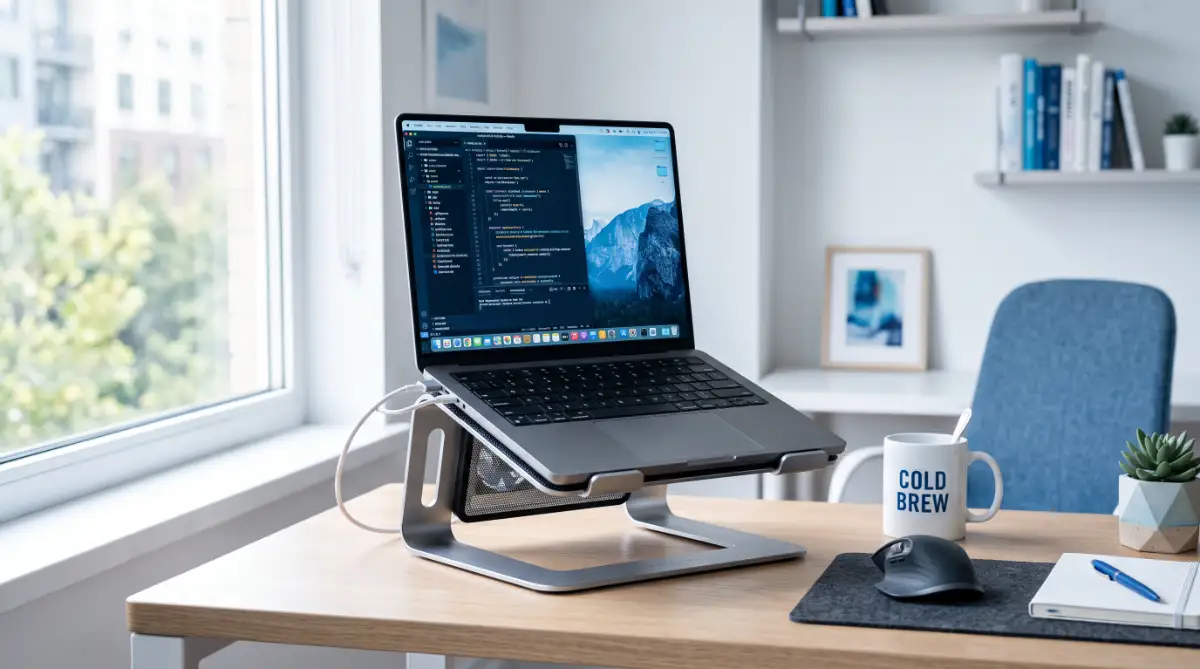
If you work in a warm environment, a high-quality aluminum stand is worth every penny. Aluminum naturally draws heat away from the laptop. Even a simple stand that lifts the back of the laptop by an inch can improve cooling by 20%.
Avoid the cheapest plastic cooling pads. They often have weak fans that don't move much air and can actually block the natural airflow of your laptop. A simple "passive" stand is often better than a cheap "active" one.
A Faster, Cooler Future Awaits
You now have all the tools and knowledge to stop your laptop from burning up. From simple things like moving to a desk to advanced tips like under volting, you are in control.
A cool laptop is a fast laptop. It is a laptop that will last you for years instead of months. You will save money on repairs and enjoy a much better experience every time you turn it on.
Take the first step right now. If your laptop is plugged in on a soft surface, move it to a desk. If you have fifty tabs open, close the ones you don't need. Your battery and your processor will thank you.
According to research from major tech hardware sites like PCMag and Microsoft Support, maintaining a lower temperature is the single most important factor for electronic longevity. You are not just fixing a heat problem; you are protecting your digital life.
Stay proactive, keep those vents clear, and enjoy the silence of a well-cooled machine. You’ve got this!
Don't wait until your screen freezes or your battery starts to bulge like I did. Taking just five minutes today to clear your desk and check your settings can keep your laptop running fast and quiet for years.
You’ve worked hard for your tech, so start these small habits now and enjoy the peace of mind that comes with a cool, reliable machine!
Disclaimer: The tips provided in this article are for informational purposes only. While undervolting and replacing thermal paste are common expert practices, they may void your warranty or cause issues if done incorrectly. Always consult your manufacturer's manual or a professional technician if you are unsure about opening your device.