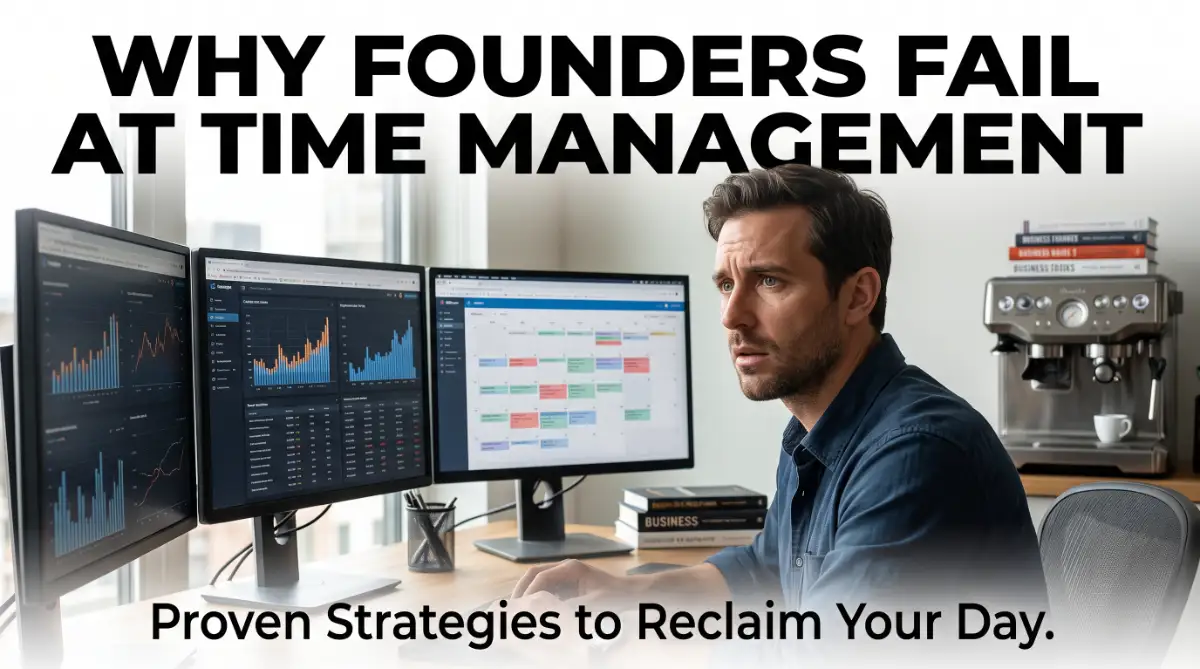
I remember my first year running a startup like it was yesterday. I was working 16 hours a day, barely sleeping, and yet my business wasn't growing at all. I felt like I was drowning in a sea of emails and small tasks that didn't really matter.
It took me a long time to realize that being busy is not the same thing as being successful, and I want to help you avoid that same trap.
Executive Summary: Reclaiming the Founder's Schedule
Most startup founders struggle with time management because they face non-stop interruptions, feel forced to handle every small detail alone, and lose sight of their main goals.
To fix this, you must learn to delegate effectively, set hard boundaries on your calendar, and focus your energy only on work that moves the needle for your business.
Why Most Founders Stay Busy but Stuck
- Constant Interruptions: Frequent Slack messages, emails, and unplanned meetings break focus all day long.
- The "Solo-Hero" Mindset: Many founders believe no one else can do the job as well as they can, leading to a bottleneck.
- Reactive Habits: Spending the whole day "putting out fires" instead of working on long-term growth.
- Mental Context Switching: Rapidly jumping between marketing, hiring, and tech ruins deep thinking and drains energy.
How to Fix Your Schedule Today
- Strict Time Blocking: Set aside 2 to 3 hours every morning for deep work with zero notifications.
- The Power of Three: Identify the three most important tasks each day and finish them before checking your inbox.
- Strategic Delegation: Trust your team with tasks that do not require your specific expertise so you can focus on leading.
- Audit Your Meetings: Cancel any meeting that does not have a clear goal or could be handled with a short message.
The Hidden Cost of the Founder’s Busy Schedule
You wake up at 6 AM with a long list of things to do. By 10 PM, you feel like you haven't finished anything important. This is the daily reality for thousands of startup founders.
You are moving fast, but you are not moving forward. It feels like you are running on a treadmill that never stops.
The stress of "not having enough time" is more than just a small worry. It keeps you up at night. It makes you snap at your team or your family.
You started this business to have freedom, but now you feel like a slave to your inbox. Most founders think the answer is to work harder or sleep less. They are wrong.
Why Common Advice Fails the Average Founder
Many founders look for answers in the wrong places. They read "hacks" that don't fit their real life. Here is why most people stay stuck in a cycle of being busy but not productive:
- Following generic "guru" advice: Most tips are made for corporate employees, not for people building a company from scratch.
- The "Hustle Culture" trap: You are told that if you aren't working 18 hours a day, you aren't trying hard enough.
- Information overload: There are too many apps and tools, and founders spend more time setting up tools than doing actual work.
- Lack of a clear system: Without a framework, you react to problems instead of leading your company.
- Chasing small wins: You answer emails because it feels good to "clear" something, even if that email doesn't help your business grow.
How Time Struggles Damage Your Mind and Growth
When you can't manage your time, your mental health pays the price. It is hard to stay confident when you feel behind every single day. This constant pressure leads to a specific kind of pain:
- Decision fatigue: By noon, your brain is tired, and you start making poor choices for your startup.
- Loss of passion: The thing you used to love now feels like a heavy weight on your shoulders.
- Burnout risk: Your body and mind can only handle so much stress before they simply shut down.
- Relationship strain: You are physically there with your family, but your mind is always on your Slack messages.
The Reality of Founder Burnout
The struggle with time is not just about a calendar. It is about how you view your value as a leader. Many founders feel they must be involved in every single tiny detail.
They think "if I don't do it, it won't be done right." This mindset is the biggest enemy of growth.
When you try to do everything, you end up doing nothing well. Your team starts to wait for your permission for every small step. This creates a bottleneck.
Your startup stops being a fast-moving machine and becomes a slow, heavy boat. You are tired, your team is frustrated, and your business stays small.
You might feel like you are failing because you can't "do it all." But the truth is, nobody can do it all. The most successful founders are not the ones who work the most hours.
They are the ones who know exactly where their time should go. They have learned to say no to the "good" so they can say yes to the "great."

Startup Time Wasters vs. Business Impact
To truly understand why your startup might be growing slower than expected, look at this breakdown of common time-management obstacles and their direct effect on your company's health.
Pro Tip for Founders:
Use this table as a weekly checklist. If you find yourself checking more than three of these boxes, it is time to step back and apply the "Big Three" rule we discussed in Part 1.
By identifying these "time leaks" early, you can save dozens of hours every month and redirect that energy into validating your small business idea or scaling your revenue.
Reclaiming Your Day: A Simple Guide to Better Focus
You don't need a fancy app or a degree in management to fix this. You need to change how you think about your hours. Let’s look at the first few steps you can take to get your life back.
I used to keep a massive digital list of 50 tasks, and it made me feel anxious the moment I woke up. One day, I decided to throw the app away and just use a small sticky note for my top three goals.
This simple change stopped my brain from freezing up and helped me finally get the big things done instead of just staying busy.
The "Big Three" Rule for Daily Success
One of the biggest mistakes is having a to-do list with 20 items. You will never finish 20 items in a day. Instead, you should focus on the "Big Three." Every morning, or the night before, pick three things that must happen.
These three things should be tasks that move the needle. If you only did these three things and nothing else, would your business be better? If the answer is yes, then those are your priorities.
Everything else is just noise. When you focus on three things, your brain feels less cluttered. You can put all your energy into doing those tasks perfectly.
Stop the "Meeting Madness" Immediately
Meetings are the biggest time-thieves in the startup world. Founders often feel they need to be in every meeting to stay "in the loop." This is a mistake. Most meetings can be a simple email or a quick chat message.
Before you agree to a meeting, ask for an agenda. If there is no clear goal, don't go. If you must have a meeting, keep it short. Set a timer for 15 or 20 minutes.
You will be surprised how much you can get done when the clock is ticking. This protects your "maker time," which is the time you spend actually building your product or talking to customers.
Learn the Power of "Deep Work" Blocks
Our brains are not meant to switch between tasks every five minutes. Every time you check a notification, it takes your brain nearly 20 minutes to get back into a deep state of focus.
If you check your phone 10 times a day, you are losing hours of high-quality thinking.
Try to set aside two hours of "Deep Work" every morning. Put your phone in another room. Close your email tab. Tell your team you are "offline" for a bit.
Use this time for your most difficult task. This is when you solve big problems or write important code. One hour of deep work is worth four hours of distracted work.
If you want to see how top performers stay focused without getting tired, watch this quick video. It shows you exactly how to train your brain to do more in less time so you can finish your work early and enjoy your day.
Why Logic Always Beats Luck in Productivity
Many people think being productive is about being lucky or having a "natural" talent for organization. That is a myth. Productivity is a logical system. If you put the right inputs into your day, you get the right outputs.
Think of your time like a bank account. You have a limited amount of "currency" to spend every day. If you spend it on small, cheap tasks, you won't have enough for the big, expensive ones. Successful founders treat their time as their most valuable asset. They don't give it away for free to anyone who asks.
By using simple logic, you can see where your time is leaking. Maybe you spend too much time on social media "research." Maybe you spend too long choosing the color of a button.
When you start tracking where your minutes go, you see the patterns. You can then fix those patterns with simple rules.
The Myth of Multitasking
We often think we are being great founders when we do five things at once. We are on a call, typing an email, and eating lunch. Science tells us this is actually making us slower. The human brain cannot multitask. It can only "task switch."
Each switch has a cost. It drains your mental battery. By the end of a day of multitasking, you are exhausted, but you haven't done anything great. You have done five things in a "good enough" way. To grow a startup, "good enough" is not enough.
You need excellence. Excellence requires single-tasking. Focus on one person, one problem, or one task at a time.
Building a "No" Muscle for Growth
As a founder, people will always want a piece of your time. New partners, "pick your brain" requests, and minor staff issues will flood your day. If you say yes to everyone, you are saying no to your business.
Saying "no" is a skill you must practice. You don't have to be mean about it. You can say, "I would love to help, but my focus is 100% on [Current Goal] right now."
Most people will respect your boundaries. Those who don't respect your boundaries are usually the ones who would have wasted your time anyway.
Protecting your time is how you protect your vision. If you don't value your hours, nobody else will. When you start saying no to things that don't matter, you create space for the things that do.
This is how you go from being a "busy founder" to a "successful CEO."
Creating a Morning Routine That Actually Works
You don't need a 10-step morning routine with ice baths and meditation if that doesn't fit you. You just need a routine that prepares your brain for work. For some, it is a 10-minute walk. For others, it is just a quiet cup of coffee without a phone.
The goal is to start the day on your terms. If the first thing you do is check email, you are starting your day on other people's terms. You are reacting to their needs.
Instead, give yourself at least 30 minutes of "you time" before you enter the digital world. This keeps your mind calm and ready for the challenges ahead.
Using Simple Tools for Automation
You don't need the most expensive software to be organized. Sometimes, a simple paper notebook is better. However, simple automation can save you hours a week.
Use tools to schedule your social media. Use a booking link so you don't have to send 10 emails just to set up one call.
Small wins in automation add up. If you save 10 minutes a day, that is an hour a week. That is 50 hours a year.
That is a whole extra week of work time you just "found." Look for things you do more than three times a week. Can a simple tool do it for you? If yes, set it up once and forget about it.
Mastering the Art of High-Level Delegation
As your startup begins to find its rhythm, you must shift your focus. You can no longer be the person who handles every customer ticket or social media post.
This is where most founders get stuck. They believe that their personal touch is required for every single task to be perfect.
This mindset is actually a trap. If you spend your day doing $20-an-hour tasks, you are not acting like a CEO. You are acting like a low-level employee.
To fix this, you need to identify tasks that someone else can do 80% as well as you. If they can hit that 80% mark, give the task to them immediately.
Delegation is not just about giving orders. It is about empowering your team to take ownership. When you step back, you give your team a chance to grow.
This frees up your brain to focus on the big picture, like why customer lifetime value is the secret to sustainable business growth. Without this shift, your business will eventually stop growing because you have run out of hours.
Building a "Founder Operating System" with Automation
Modern technology has made it easier than ever to save time. However, many founders use too many tools and get overwhelmed.
The secret is to build a simple system that runs in the background. You want to spend less time managing your tools and more time using them.
Start by looking at your repetitive tasks. Do you find yourself typing the same email response five times a day? Use a text expander. Do you manually move data from one sheet to another?
Use a simple automation tool like Zapier or Make. You can even learn how to use artificial intelligence to automate daily productivity tasks to handle scheduling and research.
Automation is like hiring a digital assistant that never sleeps. It removes the "friction" from your day. When the boring stuff is handled by a machine, you can stay in your "genius zone."
This is the area where you provide the most value to your company. According to Forbes, the most successful leaders are the ones who automate the mundane to focus on the creative.
The Power of Energy Management Over Time Management
We often talk about "managing time," but time is a fixed resource. Everyone has 24 hours. What actually changes is your energy.
If you try to do a hard task when you are tired, it will take you three hours. If you do it when you are full of energy, it might take 45 minutes.
Watch your own body clock for a few days. Are you a morning person or a night owl? Schedule your hardest, most important work during your peak energy hours.
Save the easy tasks, like filing receipts or answering basic messages, for when your brain feels a bit slow.
Managing your energy also means knowing when to stop. Taking a break is not a sign of weakness. It is a tool for better performance. A short walk or a 15-minute nap can reset your focus.
If you keep pushing while your "battery" is at 5%, you will make mistakes. It is much better to master your mind: how to stay calm and think clearly under pressure than to force yourself through a fog of fatigue.
Long-Term Sustainability: Keeping the Momentum Alive
Getting organized for one week is easy. Staying organized for a year is hard. To keep these results, you need a system that survives your bad days. Start by doing a weekly "Sunday Review." Look at what went well and what didn't.
Adjust your schedule based on real data, not just feelings. If a certain type of meeting always runs late, start booking it for the end of the day.
If you find yourself distracted by a specific app, delete it from your phone. Small, constant adjustments are what lead to long-term success.
You should also keep learning. The world changes fast, and new ways to be efficient appear every day. However, don't just jump on every new trend.
Stick to the basics that work for you. Consistency is the boring secret that every high-performing founder uses to stay at the top.

Common Traps That Kill Founder Productivity
Even with the best plan, it is easy to fall back into old habits. Many founders make the mistake of "Productivity Porn."
This is when you spend hours watching videos about being productive instead of actually working. It feels like work, but it produces zero results.
Another big mistake is ignoring your physical health. You might think skipping gym or sleep gives you more hours. In reality, it makes every hour you work less effective.
A tired brain is a slow brain. If you don't take care of your body, your startup will eventually suffer.
Many people also struggle with the "Shiny Object Syndrome." This happens when you start a new project before finishing the last one. You end up with 10 half-finished ideas and no completed products.
It is much better to have one finished, successful project than a dozen "almost there" ones. Always finish what you start before moving on.
The Danger of Micro-Managing Your Team
If you have hired people, let them do their jobs. If you are constantly checking their work or telling them how to click a button, you are wasting two people's time. You are wasting theirs, and you are definitely wasting yours.
Micro-management is often a sign of fear. You are afraid that if things aren't done your way, the business will fail. But you cannot scale a business alone.
You must learn to trust the people you hired. If you can't trust them, then you hired the wrong people.
Focus on the "what" and the "why," but let your team decide the "how." This builds a culture of trust and speed. When people feel trusted, they work harder and solve problems on their own.
This removes you from the daily fires and lets you focus on high-level growth, such as learning how to validate your small business idea before launching to the public.
Failing to Set Hard Boundaries
If your team and clients can reach you at 11 PM on a Sunday, they will. If you don't set boundaries, other people will set them for you. This leads to a life where you are always "on," but never fully present.
Set clear "off hours" where you do not check work messages. Use the "Do Not Disturb" feature on your phone. Tell your team that you are only available for true emergencies during these times. Most "emergencies" can actually wait until Monday morning.
When you have hard boundaries, your brain gets a chance to recover. This recovery is what allows you to be creative and sharp during work hours.
Think of it like a professional athlete. They don't train 24 hours a day. They train hard and then they rest hard. Your brain is your muscle—treat it with the same respect.
Your 24-Hour Action Plan for Change
You don't need to change everything today. That would be too much. Instead, start with one small win. Look at your calendar for tomorrow and remove one meeting that isn't necessary. Just one. That is your first step toward freedom.
Next, identify your "Big Three" tasks tonight before you go to sleep. Write them down on a piece of paper. Not an app, but real paper. Put it on your keyboard. Tomorrow, don't open your email until the first of those three tasks is done.
This small change will feel strange at first. You might feel an itch to check your notifications. Ignore it. Focus on the work that actually matters.
Once you feel the power of finishing a big task early in the day, you will never want to go back to your old ways.
Final Thoughts for the Ambitious Leader
Being a founder is one of the hardest jobs in the world. It is a marathon, not a sprint. The struggle with time is something we all face, but it doesn't have to define your life. By moving from "busy" to "effective," you change your entire future.
Remember that your time is the only thing you can't buy more of. You can always make more money, but you can't make more minutes.
Spend your hours on things that build a legacy. Build products that help people. Spend time with the people who love you.
Today is the day you take back control. Stop reacting to the world and start leading your life. You have the tools, the knowledge, and the drive.
Now, all that is left is to take action. Your future self will thank you for the boundaries you set today.
I promise that once you take back your time, your whole life will feel different. You will sleep better, feel less stressed, and finally see your business grow the way you always dreamed.
Don't try to be perfect; just start with one small change today and keep moving forward because you deserve to have your freedom back.
Disclaimer: The information provided in this article is for educational purposes only and does not constitute professional business, financial, or legal advice. Every startup situation is unique, and you should consult with a professional advisor before making significant business decisions. We are not responsible for any actions taken based on this content.