
Why Your Brain Shuts Down During Online Study Sessions
Last week, I sat at my desk for four hours and somehow ended up knowing more about random TikTok trends than my actual exam topics.
I felt like a total failure, staring at the same page while my brain felt like it was stuck in thick mud. I realized I wasn't lazy; I was just drowning in digital noise that I didn't know how to stop.
You sit down at your desk and open your laptop. You have three chapters to read and an assignment to finish. But ten minutes later, you find yourself scrolling through your phone or staring blankly at a wall.
Your eyes feel heavy, and your brain feels like it’s filled with thick fog. This is the reality for thousands of online students who struggle to keep their focus for more than a few minutes.
The problem isn't that you are lazy or "not smart enough." The problem is that your brain is being attacked by digital noise and bad habits that drain your energy before you even start.
The Hidden Cost of "Pseudo-Work"
Most people think they are studying when they sit in front of a screen for five hours. However, if you spent three of those hours checking notifications, you didn't really study.
- The Notification Trap: Every time your phone pings, it takes your brain nearly 20 minutes to get back into deep focus.
- Information Overload: Trying to read long PDFs while seeing ads and pop-ups makes your brain quit because it’s too much work.
- The Comfort Curse: Studying in bed or in a messy room tells your brain it’s time to relax, not time to work.
- Social Isolation: Without a teacher or classmates nearby, your mind feels free to wander wherever it wants.
How Losing Focus Destroys Your Mental Peace
When you can't focus, it doesn't just hurt your grades. It ruins your entire day and your self-confidence.
- Constant Guilt: You feel bad because you know you should be working, but you just can't bring yourself to do it.
- Late Night Stress: Because you wasted the day, you end up staying up late, which makes you even more tired the next day.
- The Feeling of Failure: Seeing others finish their work while you struggle makes you feel like you aren't cut out for online learning.
- Physical Exhaustion: Staring at a screen without a plan causes eye strain and headaches that make you hate your desk.
We are going to stop this cycle right now. You don't need a more expensive laptop or a fancy app to fix this. You just need a few smart changes to how you handle your time and your space.
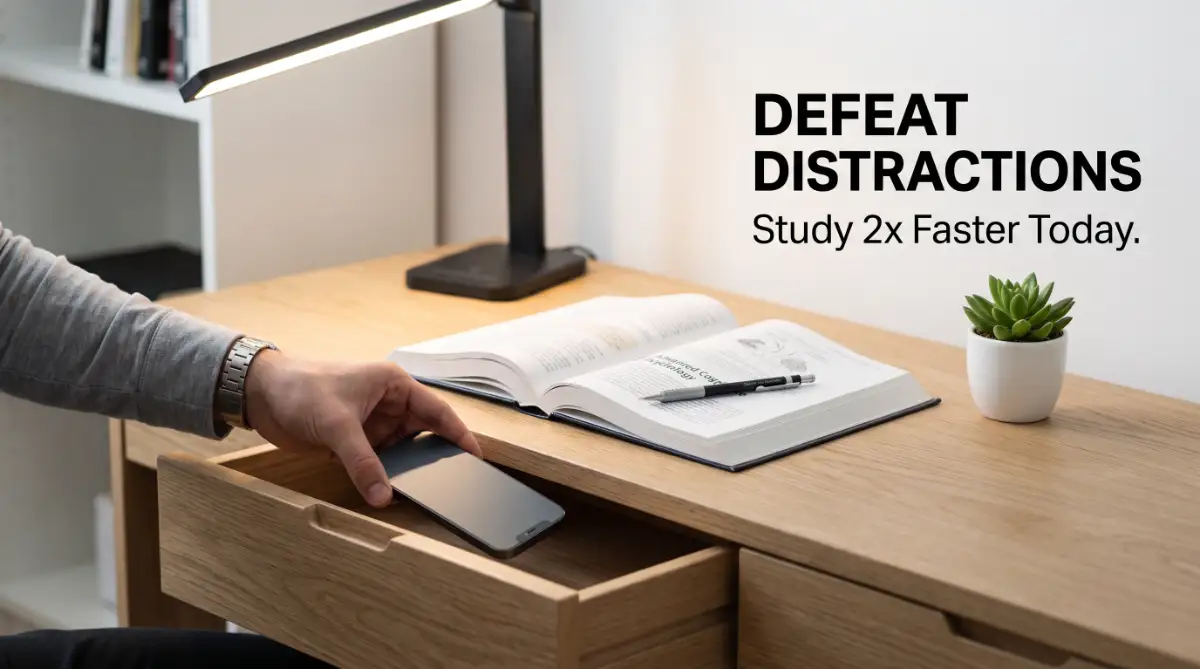
Hack 1: Create a "Sacred Study Zone" That Commands Focus
Your brain is a master at making associations. If you study in the same place where you eat or watch movies, your brain gets confused. It doesn't know if it should be working or relaxing.
The first step to fixing your focus is to pick one spot that is only for studying. It doesn't have to be a whole room. It can just be one specific corner of a table.
When you sit in this spot, your brain should automatically flip a switch into "work mode." This is how you stop the internal battle before it even starts.
How to Set Up Your Focus Zone
Keep your desk completely clear of anything that isn't related to your current task. If you are studying history, don't have your math book on the table.
Use a "Focus Trigger" like a specific desk lamp. Only turn this lamp on when you are actually studying. When the light goes off, the study session is over.
Pro Tip: If you live in a noisy house, use a "Do Not Disturb" sign on your door. This tells everyone that you are "at work" and should not be bothered for small things.
Hack 2: Use the "Airplane Mode" for Your Life
Digital distractions are the biggest enemy of the online student. You might think you can handle "just one quick look" at a message, but you can't.
Our brains are wired to seek out new information. A notification is like a hit of dopamine that makes your study material look boring by comparison.
To win this war, you have to be aggressive. You have to treat your study time like a flight where you have no choice but to stay offline.
Master Your Digital Environment
Put your phone in another room. Not just face down on the desk, but in a completely different part of the house. If you can't see it, your brain will stop thinking about it much faster.
Use browser extensions that block social media sites during certain hours. This removes the "choice" and makes it impossible to wander off.
I used to make the huge mistake of keeping my phone on "silent" right next to my mouse, thinking I was strong enough to ignore it. I wasn't.
Now, I actually hide my phone in a different room, and it’s the only way I can get my brain to stay quiet and focus on the screen.
Myth vs Reality:
- Myth: "I need my phone for the calculator or to check the time."
- Reality: You are using that as an excuse to keep the distraction near you. Use a real calculator and a physical clock instead.
Hack 3: The "5-Minute Starting Rule" to Beat Procrastination
The hardest part of any long study session is the first five minutes. This is when your brain feels the most resistance because the task looks too big.
When you look at a 50-page chapter, your mind thinks about the hours of work ahead. This causes stress, and stress makes you want to go to YouTube for "relief."
The 5-minute rule is a simple trick to bypass this fear. You tell yourself, "I am only going to do this for five minutes. If I want to stop after that, I can."
Why This Works So Well
Most of the time, the "pain" of studying is just the fear of starting. Once you open the book and read the first few lines, that fear disappears.
Action creates motivation, not the other way around. You don't wait to feel motivated to study; you start studying to feel motivated.
Real-Life Scenario:
Imagine you have to write a long essay. Don't think about the 2,000 words. Just tell yourself to write three sentences about the topic. Usually, those three sentences turn into three pages because you've broken the "starting barrier."
If you find it impossible to just get started, watch this short video to see the 5-minute rule in action. It’s a total game-changer for your focus, and once you’ve seen it, keep reading below to learn how to clear your mental clutter.
Hack 4: Brain-Dumping Before You Dive In
Have you ever tried to study, but you kept thinking about your grocery list or a text you forgot to send? This is called "mental clutter."
Your brain is trying to remember these small tasks while also trying to learn new information. This is like trying to run a computer with 50 tabs open in the background.
It’s going to be slow and it’s going to crash.
A brain dump is a 2-minute exercise that clears your mental RAM so you can focus on the task at hand.
How to Do a Proper Brain Dump
Take a blank piece of paper and write down everything that is currently on your mind. This includes chores, worries, and random ideas.
Once it is on paper, your brain feels safe "forgetting" it for a while. You know the information is recorded, so you don't have to keep repeating it in your head.
Keep this paper on the side of your desk. If a random thought pops up while you are studying, quickly write it down and go back to your work immediately.
Hack 5: Optimize Your Lighting and Air Flow
Most students ignore their physical environment, but it has a massive impact on concentration. If your room is too dark, your body starts producing melatonin, the sleep hormone.
If the air is stale or the room is too hot, your brain starts to feel sluggish. You might think you are tired of studying, but you might actually just be tired of bad air.
Small physical changes can give you a 20% boost in how long you can stay awake and sharp.
Creating the Perfect Atmosphere
Open a window if possible. Fresh oxygen helps your brain process information much faster than a closed, stuffy room.
Use cool, white light for your desk. Warm yellow light is great for relaxing, but cool light helps you stay alert and focused on the screen.
Comparison Table: Good vs. Bad Study Environments
Hack 6: The "Single-Tab" Philosophy
Multitasking is a lie. Your brain cannot do two things at once; it just switches between them very fast. This switching costs you a lot of mental energy.
When you have 15 tabs open in your browser, each one is a tiny invitation to lose focus. You see a "1" on a tab and you wonder what it is.
The "Single-Tab" philosophy means you only keep the tabs open that you are actively using for the current minute of work.
How to Clean Up Your Digital Workspace
Close your email, close your chat apps, and close any news sites. If you need a reference, open it, use it, and then close it again.
If you find a cool article you want to read later, use a "read it later" app instead of leaving the tab open. This keeps your screen clean and your mind calm.
Remember, a cluttered screen leads to a cluttered mind. When there is only one thing to look at, there is only one thing to think about.
Hack 7: Feed Your Brain for High Performance
You wouldn't put cheap, dirty fuel in a race car and expect it to win. Yet, many students eat sugary snacks and drink five energy drinks while studying.
Sugar gives you a quick "high," but it is always followed by a massive "crash." When you crash, your focus disappears, and you feel irritable.
If you want to stay focused for a long online session, you need to eat foods that provide slow, steady energy to your brain.
Brain Food Essentials
Drink plenty of water. Even slight dehydration can lead to a 10% drop in cognitive performance. If you feel a headache coming on, drink a glass of water first.
Snack on nuts, seeds, or fruit instead of candy. These provide healthy fats and fiber that keep your blood sugar stable for hours.
Expert Insight:
Avoid heavy meals right before a big study block. When you eat a large meal, your body sends blood to your stomach to digest the food.
This means there is less blood and oxygen going to your brain, which is why you feel "food coma" or sleepiness after lunch.
Beyond the Basics: Mastering Your Mental Stamina
Now that you have your desk ready and your phone hidden, it is time to look at how your brain actually works. Online learning is different because you are in charge of your own schedule.
This means you need a higher level of self-control than a student in a physical classroom.
One of the most effective ways to stay sharp is through "Time Boxing." Instead of saying you will study "in the afternoon," give yourself a strict window of time. For example, tell yourself you will work from 2:00 PM to 4:00 PM.
When you have a closing time, your brain works faster. It knows that the work will eventually end, so it doesn't feel the need to wander as much. This is a great way to master your mind and stay calm even when the lessons get difficult.
The Power of Active Recall
Many students make the mistake of just reading their notes over and over. This is called "passive learning," and it is very boring for your brain. When you are bored, your focus naturally drops because your mind wants something more exciting to do.
Instead, try Active Recall. After reading a page, close the book and try to explain what you just read out loud. If you can explain it to an imaginary friend, you actually know the material.
According to research from the Association for Psychological Science, testing yourself is far more effective than re-reading.
It forces your brain to "dig out" the information, which makes the memory much stronger. This keeps you engaged and prevents that sleepy feeling during long sessions.
Keeping Your Technology in Top Shape
Nothing breaks your focus faster than a laptop that starts lagging or overheating in the middle of a lecture. When your tools fail, your frustration levels go up, and your concentration goes down. You lose that "flow state" that is so hard to find.
If you are using an older device, you need to make sure it can handle long study hours. A simple way to stay productive is to stop laptop overheating with easy fixes so you don't have to deal with sudden crashes.
Also, make sure your battery is healthy. Constantly worrying about your charger is a tiny distraction that adds up over time.
If you want to avoid these technical headaches, learn how to extend your battery lifespan to keep your focus on the lesson rather than the power outlet.
The 50/10 Focus Sprint
You might have heard of the Pomodoro technique, but for long online sessions, the 50/10 rule often works better. You study for 50 minutes of deep, uninterrupted work, and then take a 10-minute total break.
During those 10 minutes, you must get away from all screens. Don't check your phone or watch a video. Instead, walk around, stretch, or grab a glass of water.
This gives your eyes a break from the "blue light" of the laptop. When you come back to your desk, you will feel like you have a fresh brain ready to go again.

The Silent Focus Killers You Need to Avoid
Even if you follow every tip, there are some common traps that can ruin your progress. These "focus killers" often look harmless, but they are the reason many students fail to finish their online courses.
1. The Myth of Multitasking
Many students think they can listen to a lecture while also responding to a quick email. This is a huge mistake. Every time you switch your attention, you pay a "switching cost."
Your brain takes time to refocus on the complex study material after looking at an email. This makes the study session feel much harder than it actually is. It also leads to more mistakes in your assignments.
2. Studying in Your "Sleep Zone"
Never study in your bed. Your brain sees the bed as a place for rest and relaxation. If you try to study there, you are fighting a biological battle you will likely lose.
Within 20 minutes, you will start feeling sleepy or lazy. Keep your work and your sleep completely separate to maintain high mental energy.
3. Neglecting Your Sleep Quality
You cannot focus if your brain is tired. Sleep is when your brain "cleans" itself and moves what you learned into your long-term memory. If you skip sleep to study more, you are actually forgetting what you learned the day before.
If you struggle to stay awake during the day, it’s time to fix your nighttime routine. You can use these daily habits to transform your sleep quality so you wake up with a sharp, focused mind.
According to experts at Healthline, lack of sleep has the same effect on your brain as being drunk. You wouldn't try to study while drunk, so don't try to study while exhausted.
4. Overloading on Caffeine
A little coffee is fine, but too much will make you jittery. When your heart is racing from caffeine, it is very hard to sit still and focus on a complex topic.
Eventually, the caffeine wears off and you hit a "crash." This crash usually happens right when you have the most work left to do. Stick to water or green tea for a more stable energy level.
5. Using "Easy" Study Materials Only
Sometimes we spend time looking for the perfect summary or the easiest video instead of just doing the hard work. This is a form of procrastination.
While it is great to find secrets to access free pro learning materials, don't let the search for tools stop you from actually starting. Use the tools to help you, not to replace the effort.
Your New Daily Action Plan
You now have a complete toolkit to fix your focus. You know how to set up your room, how to trick your brain into starting, and which mistakes to stay away from. But the most important part is what you do tomorrow morning.
Don't try to change everything at once. Pick two hacks from this guide and try them out for one week. Maybe start with the "Phone in another room" rule and the "50/10 Focus Sprint."
Small Wins Lead to Big Results
Once those habits feel easy, add another one. Online study doesn't have to be a painful struggle. When you have a system, it actually becomes quite satisfying to check tasks off your list.
Imagine how good it will feel to finish your work three hours earlier than usual. You will have more time for your hobbies, your friends, and your rest without any guilt hanging over your head.
You have the power to take control of your education. You aren't "bad at focusing"; you just needed a better plan. Now you have that plan, so go out there and show yourself what you are truly capable of.
Expert Final Checklist:
- Is my phone in a different room? (Yes/No)
- Do I have a clear goal for the next hour? (Yes/No)
- Is my laptop plugged in and cool? (Yes/No)
- Did I do a 2-minute brain dump? (Yes/No)
If you can say "Yes" to these four things, you are already ahead of 90% of other students. Your journey to better grades and a calmer mind starts with the very next click of your mouse.
Changing these small habits finally stopped that heavy feeling of guilt I used to carry every night.
You don't have to change everything at once, but once you take that first step, you’ll be amazed at how much free time you actually have. Go ahead and clear your desk right now—your future self will thank you for it!
Disclaimer: The information provided in this post is for educational and informational purposes only. While these study techniques are based on common productivity practices, individual results may vary depending on learning styles and personal health. Always consult with an educational advisor or a health professional for specific advice regarding learning disabilities or chronic focus issues.