
Why Choosing the Right Freelance Skill Feels Impossible (And What I Got Wrong)
Not long ago, I sat at my kitchen table at midnight with fourteen browser tabs open. Every tab promised the one skill that would finally set me free from my job.
I bought a course on Monday, switched to a different one by Thursday, and signed up for a third before the month ended. By then I had spent a few hundred dollars and still could not do a single task a client would pay for.
I felt like everyone else had a secret map and I had left mine at home. Looking back, my problem was never talent. I was chasing hype instead of following a plan.
Maybe you know this feeling. You scroll through videos late at night, and every creator swears their skill is the best one. By morning, you feel more confused than before.
Here is what that confusion does to real people. You lose sleep wondering if you picked wrong. You feel guilty about the course you never finished, and you watch friends post about side income while your bank balance stays flat.
It hits home too. Maybe you are a parent who needs flexible hours, a college student juggling loans and shifts, or a worker who is tired of a 9-to-5 with no room left for your own plans. Every week without a direction feels like a week stolen from you.
Picture a nurse who works three long shifts a week and wants extra income from her couch. She tries writing for two weeks, then design for two more, then quits because nothing feels like progress. Her problem is not effort. It is scattered effort.
Then comes the quiet doubt. You start to wonder if online work is only for other people. It is not.
Here is the good news. Choosing a freelance skill is a skill by itself, and you can learn it fast. Once you know how to judge demand, difficulty, and your own strengths, the fog clears.
How to Pick the Best Freelance Skills to Learn Without Wasting Money
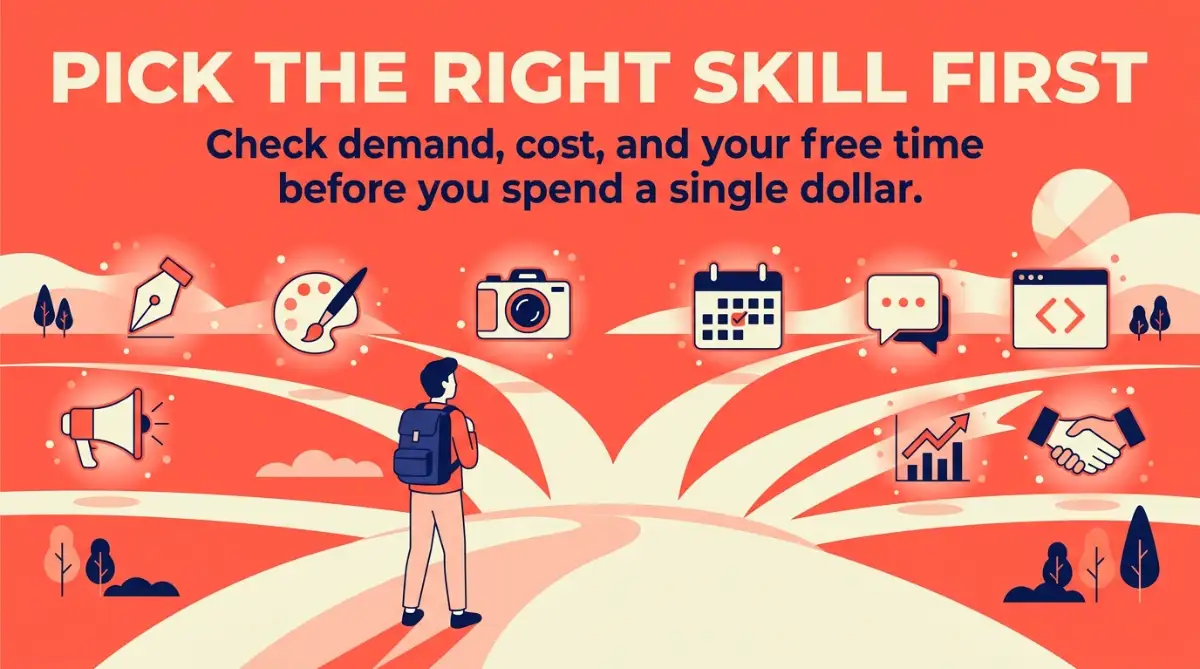
Before we get to the list, let’s build a simple filter. These three checks would have saved me from my worst buying decisions.
Start With Real Demand, Not Social Media Hype
Open a freelance marketplace or a job board and search each skill you are curious about. Count how many US businesses are actually asking for it. A skill with steady postings beats a trending skill with almost none.
Think of it like opening a food truck. A great taco recipe means little if nobody on your street eats tacos. Demand first, passion second is a smart rule when income is the goal.
Match the Skill to Your Time, Budget, and Starting Point
Be honest about how many hours you have each week. A parent with five free hours should not pick a skill that needs six months of full-time study. Choose something you can learn in small pieces.
Also check the cost to start. Some skills need only a laptop and free tools, while others need paid software or a powerful computer. Low startup cost is a big win when you are only testing the water.
Run a Small Test Before You Commit
Pick one skill and spend two weeks making a tiny sample project. Write a short blog post, design a simple flyer, or edit a thirty-second clip. If you enjoy it and the result looks decent, keep going.
My Pro Tip: I once paid for an advanced course before I tried a single free lesson. By week two I hated the work, and I could not get a refund. Now I always do a free two-week test first.
Want to see how working freelancers choose their first skill? Watch this short video, then come back for the full list below.
9 High-Paying Freelance Skills Worth Learning Right Now
You will find plenty of lists of the top 10 freelancing skills online, but most never tell you who each skill actually fits. This list does. If you only want the top 5 freelancing skills in-demand with US clients, start with the first five below.
These are also some of the best freelancing skills for beginners, because most of them can be learned with free or low-cost tools. Your earnings will depend on your effort, your niche, and your clients, and nobody can promise a number.
1. Freelance Writing and Content Creation
Blogs, website copy, emails, and product descriptions are needed by almost every business. You only need a laptop and strong basic English.
Writing is one of the cheapest skills to start, which is why so many students begin here. Write a few sample articles on topics you already know, then pitch small local businesses first.
2. Graphic Design
Small businesses constantly need logos, social posts, and flyers. You can start with free design tools and move to professional software later.
A clean portfolio of five to ten samples matters more than a degree. Many designers land steady monthly work by offering a social media pack instead of one-time logos.
3. Video Editing
Short videos power YouTube, Instagram, and TikTok, and busy creators hate editing. Learning cuts, captions, and sound cleanup is enough to get started.
Editors who can turn one long video into several short clips are especially popular. Practice on your own footage, then offer a free sample to a small creator.
4. Virtual Assistance and Admin Support
Business owners hand off email, calendars, data entry, and customer messages. This is one of the best freelance skills for beginners because you can learn most of it on the job.
Many assistants later specialize in project management or bookkeeping. That is how a simple starter skill grows into a higher-paying one.
5. Social Media Management
Brands want someone to plan posts, reply to comments, and track results. Learn a scheduling tool and the basics of what works on each platform.
Pinterest and Instagram skills are often in demand with small online shops. Show a before-and-after of a page you improved, even if it was your own.
6. Web Design and WordPress Setup
Many small businesses still need a simple, good-looking website. Modern site builders let you design pages without writing any code.
Knowing how to make a site load fast and look good on phones is a real selling point. Clients love freelancers who explain things in plain English.
7. Digital Marketing and SEO
Companies want more customers from search engines and email. Learn keyword research, on-page basics, and how to read simple analytics.
Freelancers who can explain results in plain numbers earn trust quickly. Start by improving a small site you own, then use that as your case study.
8. Bookkeeping and Basic Accounting
Small businesses across the US need someone to keep their books tidy. Learning popular accounting software and how to categorize expenses is a good start.
This skill stays steady because every business has to track money. Check your local rules before offering tax advice, since that can require a license.
9. AI-Assisted Work and Workflow Automation
Businesses want people who can use AI tools to draft, research, and speed up routine tasks. Clients pay for good judgment, not for button-clicking.
Many experts expect this to be among the most demanding freelancing skills in future hiring, though nobody can be sure. Always review AI output yourself before it reaches a client.
Quick Comparison: Which Skill Fits Your Life?
| Skill | Startup Cost | Learning Curve | Best For |
|---|---|---|---|
| Writing | Very low | Gentle | Students, parents, word lovers |
| Graphic design | Low to medium | Moderate | Visual thinkers |
| Video editing | Medium | Moderate | Short-video fans |
| Virtual assistance | Very low | Gentle | Fast starters |
| Social media management | Low | Gentle | Organized planners |
| Web design | Low to medium | Moderate | Detail-minded people |
| Digital marketing and SEO | Low | Moderate to steep | Analytical minds |
| Bookkeeping | Low to medium | Moderate | Number lovers |
| AI-assisted work | Low | Moderate | Curious, quick learners |
Freelance Myths That Waste Months of Your Time
Myth: You need a college degree to get clients.
Reality: Most clients care about samples and results. A strong portfolio often speaks louder than a diploma.
Myth: You must pick one perfect skill forever.
Reality: Most freelancers start with one skill and add related ones later. A writer may add SEO, and a designer may add video.
Myth: Freelancing pays well right away.
Reality: Your first clients usually take weeks of practice and outreach. Be patient, and be wary of anyone who promises fast money.
Myth: Low prices win the best clients.
Reality: Very low rates often attract the hardest clients. Fair pricing shows you take your work seriously.
Best Freelance Skills for Students (and Anyone Short on Time)
The best freelance skills for students are the ones you can practice in short sessions between classes. Writing, virtual assistance, and social media management fit this pattern well.
A student with ten free hours a week can build three solid samples in a month. That is enough to start pitching local businesses, and it gives you real work to show on a resume.
Does Your State Change the Best Freelance Skills to Learn?
Freelance work happens online, but local business needs still shape what clients ask for. Here is a friendly look at what tends to be popular around the US.
The South
If you are exploring the best freelance skills in Alabama, Mississippi, or Arkansas, start with services that small local shops always need. Social media help and simple bookkeeping are good places to begin.
In Louisiana, food and tourism brands often want strong photos and short videos. Video editing and content writing can be a smart match there.
Georgia, Florida, and Kentucky
For the best freelance skills in Georgia and Florida, think content writing, video editing, and digital marketing. Both states have busy tourism, real estate, and service businesses that need steady online content.
In Kentucky, virtual assistance and bookkeeping often work well for small employers who have little time for admin work.
The West and Southwest
People searching for the best freelance skills in California often look at web design, SEO, and video, because startups and creative studios are everywhere. Competition is high, so a clear niche helps you stand out.
In Arizona and Colorado, outdoor brands, home services, and growing local companies often need marketing and design help. Idaho’s remote-friendly workers can do well with writing and virtual assistance.
Alaska and Hawaii
The best freelance skills in Alaska often suit seasonal and remote workers who want flexible hours. Writing, editing, and virtual assistance travel easily, even from far-off places.
In Hawaii, tourism and local shops need good visuals and social media. Graphic design and content creation can fit that need nicely.
The Midwest
Looking for the best freelance skills in Illinois, Indiana, or Michigan? Business services, manufacturing, and logistics companies often need writers, marketers, and bookkeepers.
The best freelance skills in Iowa, Kansas, Minnesota, and Missouri often connect to farming, health care, and family businesses. Simple websites and clear email marketing can go a long way there.
The Northeast and Mid-Atlantic
In Connecticut, Delaware, and Maryland, finance and professional service firms often look for bookkeeping, writing, and marketing support. Clear, polished work is a strong advantage.
If you want the best freelance skills in Massachusetts, think education, health, and tech content. Maine’s tourism and seasonal businesses often want social media and design help.
Reading From Outside the US?
Many US clients hire freelancers from other countries, so these skills travel well. Here is a quick guide for readers in the UK, Canada, and Australia.
In the UK, freelancers in England often find demand in marketing, design, and bookkeeping. The best freelance skills in Scotland, Wales, and Northern Ireland often include writing, web design, and virtual assistance for growing small firms.
In Canada, the best freelance skills in Alberta and British Columbia often include digital marketing and video editing. Manitoba, New Brunswick, Newfoundland and Labrador, and Nova Scotia freelancers can do well with writing and virtual assistance for local and US clients.
In Australia, the best freelance skills in New South Wales and Victoria often include design, SEO, and social media work. Freelancers in Queensland, South Australia, Tasmania, and Western Australia can also find steady work in writing, bookkeeping, and online admin support.
A Simple 30-Day Plan to Start Freelancing
You do not need a perfect plan. You need a simple one you will follow.
- Week 1: Check real demand for three skills and pick one.
- Week 2: Take free lessons and finish one small test project.
- Week 3: Build three simple samples you are proud of.
- Week 4: Pitch ten small businesses or post your services on a freelance marketplace.
Expect a few “no” replies. That is normal, and each one teaches you how to pitch better.
Pick One Skill and Start This Week
The best freelance skill is the one you will actually practice. It should fit your time, your budget, and the kind of work you can see yourself doing.
I wasted months because I kept hopping between ideas. Don’t repeat my mistake. Pick one skill, give it thirty focused days, and let real results guide your next step.
Making Your Freelance Income Last: Habits the Pros Rely On
Getting your first client feels great. Keeping the work steady for years is a different game, and that is where most beginners slip.
Here are the habits I wish someone had handed me on day one.
Stack Two Skills Instead of Chasing Ten
Lists of the top 100 freelancing skills look exciting, but nobody can learn a hundred things. One main skill plus one helper skill beats a long list of half-learned ones.
A writer who learns basic SEO can charge more than a writer who only types words. A designer who can edit short videos becomes a one-stop shop for small brands.
Price Your Work by the Result, Not the Hour
When I started, I charged by the hour and felt guilty every time I got faster. That was backwards.
Clients care about what they get, not how long it took. Offer a fixed price for a clear result, like “five blog posts” or “a month of social media posts.” You get rewarded for getting better.
Build a Simple System for Finding Clients
Waiting for clients to find you is like waiting for rain in a desert. Pick one outreach habit and repeat it weekly.
Send five short, friendly pitches every Monday. Keep a simple sheet with the date, the business, and the reply. If you want a deeper walkthrough on building proof of your work, this guide on building a portfolio that attracts steady monthly clients is a good next read.
Treat Your Money Like a Small Business Would
Freelance income rarely arrives in a straight line. One month feels rich, the next feels thin.
Set aside a slice of every payment for taxes, since freelancers usually handle their own. The IRS keeps a helpful self-employed individuals tax center that explains the basics in plain English. To smooth out the ups and downs, learn how to create a realistic monthly budget when you have irregular income.
Use AI as a Helper, Not a Replacement for Your Brain
Smart freelancers use AI tools to speed up research, outlines, and repetitive chores. The judgment, the voice, and the final check still belong to you.
If you want ideas for saving hours each week, see how to use artificial intelligence to automate daily productivity tasks.
Keep a Weekly Learning Slot
One hour a week adds up to more than fifty hours a year. Use it for one new tool, one new technique, or one case study from a freelancer you admire.
I protect mine on Friday mornings. Clients rarely email then, so the hour stays mine.

Freelance Mistakes That Quietly Drain Your Time and Money
Most freelance failures are not dramatic. They are small leaks that go unnoticed until you feel exhausted and broke.
Let me walk you through the ones I see again and again.
Chasing Every Trend
Picture Jamie, who learned video editing for three weeks, switched to coding after watching one viral clip, then moved on to a third skill. Six months later, Jamie had three beginner-level skills and no clients.
Skill hopping feels like progress, but it resets your clock every time. Pick one lane and stay for at least three months before judging it.
Working for Free for Too Long
A free sample or two can help you build proof. A pile of free projects only teaches clients that your time costs nothing.
Set a limit before you begin, like two unpaid samples, and then move to paid work. If you need a gentle starting point, try how to get paid to write with zero experience.
Ignoring Contracts and Deadlines
Vague promises create vague payments. A client who says “just do a little extra” can turn a small job into a monster.
Always write down the scope, the price, the number of revisions, and the due date. If you would like a refresher on reading agreements carefully, see how to carefully read and understand a legal contract before signing.
Falling for Fake Job Offers
This one hurts the most, because it often hits people who are already stressed about money. Scammers love freelancers who feel desperate.
Be wary of anyone who asks you to pay a fee to get hired, or sends a check and asks you to return part of it. The FTC explains the warning signs clearly in its guide to spotting and avoiding job scams.
Do’s and Don’ts at a Glance
Do:
- Pick one main skill and stick with it for a full test period
- Put every project in writing before you start
- Save part of each payment for taxes
- Ask for deposits on larger projects
Don’t:
- Pay anyone to “unlock” a freelance job
- Quote prices without knowing the scope
- Skip your weekly outreach when you feel busy
- Promise results you cannot control
The Real Cost of Ignoring These Mistakes
The biggest loss is not money. It is months of confidence that you never get back.
Many people quit freelancing after one bad experience and decide it is not for them. In truth, most of those problems are easy to fix once you can see them.
Which Freelance Skills Fit Your State? A Friendly Local Guide
Freelancing works from anywhere, but your local economy shapes who needs help first. Here is a quick regional tour to spark ideas.
The Mountain West and Plains
The best freelance skills in Montana and Wyoming often fit small lodges, ranches, and outdoor brands, so photo editing, simple websites, and social media work well.
The best freelance skills in Nebraska, North Dakota, and South Dakota often connect to farming, insurance, and local services. Bookkeeping and email marketing are solid places to begin.
If you are looking at the best freelance skills in Utah, think tech startups and growing service companies, where marketing and web design are often welcome.
The Southwest and West Coast
The best freelance skills in Nevada often connect to hospitality and entertainment, so content writing and video editing can fit well.
The best freelance skills in New Mexico often include design and writing for art, tourism, and local food businesses. In Oregon and Washington, remote-friendly teams often look for SEO, content, and virtual assistant support.
The South and Mid-South
The best freelance skills in Texas often include digital marketing, bookkeeping, and web design, because small businesses are everywhere. The best freelance skills in Oklahoma and Tennessee often lean toward admin support, content writing, and social media help.
Folks exploring the best freelance skills in North Carolina and South Carolina can look at healthcare content, real estate marketing, and tourism visuals. The best freelance skills in Virginia and West Virginia often include writing, virtual assistance, and government-contractor support tasks.
The Great Lakes and Ohio Valley
The best freelance skills in Ohio and Wisconsin often include bookkeeping, B2B writing, and marketing for manufacturers and small shops. Local employers there often like clear, steady communication more than flashy portfolios.
The Northeast
The best freelance skills in New York often include design, video, and content marketing, since agencies and media brands are packed into one region. Competition is strong, so a clear niche helps.
For the best freelance skills in New Jersey and Pennsylvania, think healthcare writing, finance support, and e-commerce help. The best freelance skills in New Hampshire, Vermont, and Rhode Island often fit boutique shops, tourism, and local food brands that need simple websites and social media.
Quick Look at the Market for High Paying Freelance Skills in the USA
When people search for high paying freelance skills USA clients ask for most, the same names keep popping up: digital marketing, SEO, web design, video editing, bookkeeping, technical writing, and AI-assisted work.
If you want a shortlist of 7 high paying freelance skills to compare, start with those seven and test each one for two weeks. For a closer look at one of them, read how to start a virtual assistant business step by step.
Reading From Outside the US?
Many US clients hire freelancers from other countries, so here is a short global view.
United Kingdom: The top freelance skills in the UK often include marketing, design, and bookkeeping for small firms.
Canada: The in demand freelance skills in Canada often include digital marketing, translation, and web design. Freelancers in Ontario and Quebec often see strong demand for bilingual content, while the best freelance skills in Saskatchewan and Prince Edward Island often lean toward admin support and local-business marketing. In the Northwest Territories, Nunavut, and Yukon, remote-friendly skills like writing, editing, and virtual assistance travel well because clients can be anywhere.
Australia: In the best freelance skills Australia market, design, SEO, and social media are popular. The best freelance skills in the Australian Capital Territory often connect to government and professional services, while the best freelance skills in the Northern Territory often suit tourism, mining services, and remote-friendly admin work.
Keeping Your Skills Future-Ready
Trying to guess the top 10 most demanding freelancing skills is a fun exercise, but trends change quickly. Check job boards every few months and look at what clients actually post.