I walked away from my office job with zero plan and zero samples. I felt like a fraud every time I opened a job board, but I quickly learned that clients care about results, not fancy degrees.
If you want to work from home but feel like you have no skills, this is the exact plan I used to get hired from scratch.
Stop Overthinking and Start Writing Your Own Success
It is easy to feel like a fraud when you don’t have a portfolio, but I want you to know that your voice matters more than a piece of paper. Most people fail because they wait for permission to start. I spent months in that same trap, thinking I wasn't "ready." But the truth is, you don't need permission; you just need a solid plan to show clients what you can do. Let’s look at how we can bridge that gap together right now.
Quick Guide: How to Start Today
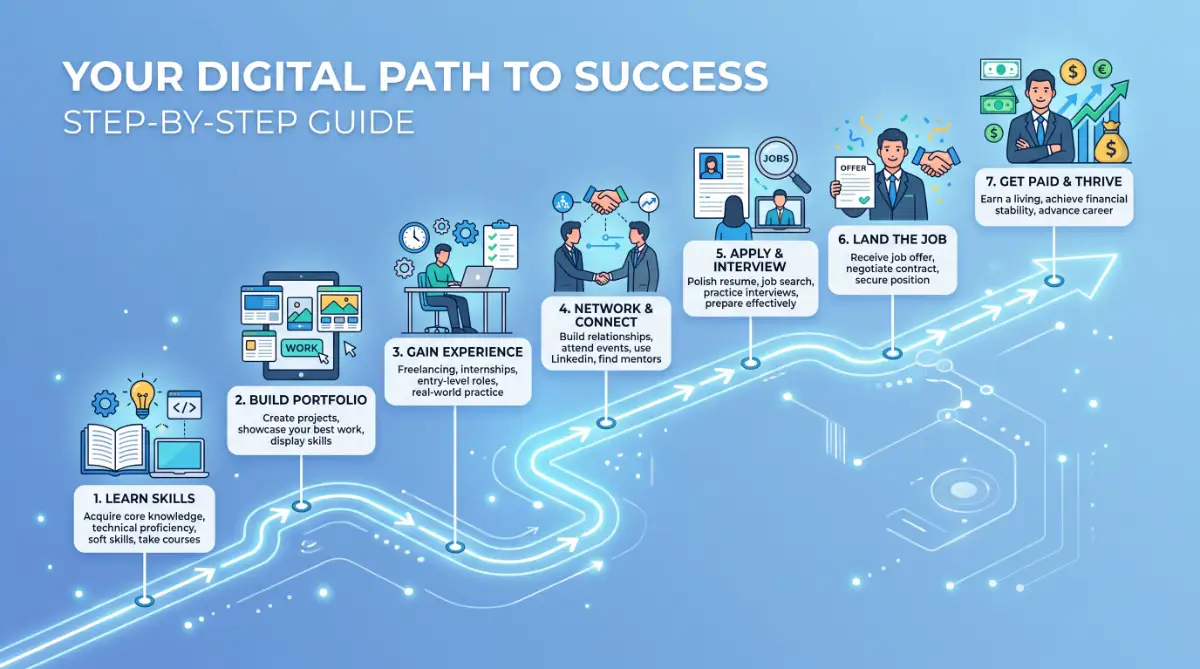
- Forget the Degree: Clients care about your writing samples more than your diploma.
- Pick a Niche: Focus on one topic (like Tech or Health) to look like an expert faster.
- Create 'Spec' Pieces: Write 3 great articles on your own to build a portfolio for free.
- Master the Pitch: Focus on how you can help the client, not just why you need a job.
- Be Reliable: Meeting deadlines is the fastest way to get repeat work.
Building Your Foundation: The "No-Experience" Success Map
You do not need a degree or a decade of work history to be a professional writer. What you need is a plan that proves you can provide value to a business. Let's walk through how to build that foundation from the ground up.
Finding Your "Writing Sweet Spot"
Many beginners make the mistake of trying to write about everything. They want to write about pets, space travel, and crypto all at once. While it sounds good to be flexible, it actually makes you look like an amateur.
Think about it like this. If you have a heart problem, do you go to a general doctor or a heart specialist? You go to the specialist. Clients are the same. They want to hire someone who understands their specific world.
To find your sweet spot, look at the intersection of three things: what you know, what you enjoy, and what people pay for. If you love gardening and have a beautiful backyard, that is a niche.
If you are a former teacher, you can write about education technology. This "insider knowledge" is your secret weapon that replaces traditional experience.
Quick Niche Comparison for New Writers
Creating a Portfolio from Thin Air
"How can I get experience if no one hires me? And how can I get hired if I have no experience?" This is the classic catch-22. The secret is that you don't need a client to have a sample.
You can create your own portfolio today by writing "spec pieces." These are articles you write for yourself to show what you can do. You don't need permission to write a great blog post about "Top 10 Budget Travel Tips" or "How to Manage Stress at Work."
Once you have 3 to 5 high-quality articles, you need a place to put them. You can use free platforms like Medium or LinkedIn. These sites look professional and give you a link you can share with potential clients.
When a client sees a well-written, helpful article, they won't care if you were paid for it or not. They will only care that you can write well.
I used to think I couldn't call myself a writer until someone paid me first. My biggest mistake was waiting for a "real" job to start my portfolio.
I finally realized that writing a few great posts for myself on my own time was exactly what showed my first client that I could handle their work.
The Art of the Modern Pitch
Pitching is simply reaching out to a business and offering your help. Most beginners send pitches that are all about them. They say, "I am a writer and I need a job." This doesn't work.
A successful pitch is all about the client. You should identify a problem they have and show how your writing can fix it. For example, if you see a company with a blog that hasn't been updated in months, you can offer to help them bring it back to life.

Instead of saying "Hire me," say " I have some ideas that could help your brand reach more customers." This simple shift in tone makes you look like a partner rather than a beggar. It shows you understand business, which is often more important to clients than your actual writing degree.
💡 My Expert Tip: The "48-Hour Rule"
When you start, don't spend weeks on one article. Write a draft today, edit it tomorrow, and publish it on LinkedIn the day after. Speed is your friend when you have no samples. Getting "done" is more important than being perfect in the beginning.
To succeed as a writer in 2026, you need to know exactly what clients are looking for right now. Watch this updated roadmap to see how to land your first client this year without any prior portfolio! Once you've watched the video, keep reading below to master the professional routine that will keep those clients coming back.
Developing a "Pro" Daily Routine
Freelance writing is a business, and you must treat it like one. If you only write when you feel "inspired," you will never make a full-time income. You need a schedule that keeps you moving forward even when you feel tired.
Set aside specific hours each day for two things: writing and marketing. In the beginning, you might spend 80% of your time marketing and 20% writing. As you get more clients, that will flip.
Treat your writing time as sacred. Turn off your phone, close your social media tabs, and focus. Even if you are just writing practice pieces, do it with the same care you would give a $500 client.
This builds the "writing muscle" that will carry you through your entire career.
Using Technology to Your Advantage
In the modern world, you have tools that can make your writing look much more professional. You don't need to be a grammar genius to be a writer.
Tools like Grammarly or the Hemingway App can help you catch mistakes and simplify your sentences.
However, do not rely on these tools to do the thinking for you. Your unique voice and your personal stories are what people actually pay for. Technology should be your assistant, not your replacement.
When you use these tools to polish your work, you present a clean, professional image to the world. This helps bridge the gap between being a beginner and being a pro.
It shows you have high standards for your work, which is exactly what high-paying clients are looking for.
Understanding the Client's Perspective
To succeed, you must put yourself in the shoes of the person hiring you. Why do they want a writer? They want to save time, earn more money, or look more professional.
If you can prove that you are reliable and easy to work with, you will beat out writers who are more "talented" but hard to reach. Being the person who always meets deadlines and responds to emails quickly is a superpower.
In the freelance world, "done" is often better than "perfect." Clients would rather have a solid, well-researched article on time than a "master piece" that is three days late. Focus on being the most reliable person your client has ever worked with, and you will never run out of work.
Preparing for the Long Game
Success in freelance writing doesn't happen overnight. It is like planting a tree. You have to water it every day for a long time before you see any fruit. But once the tree grows, it provides shade and fruit for years to come.
Don't let the first month of low earnings discourage you. Use that time to learn, to grow your network, and to sharpen your skills. Every article you write is a brick in the foundation of your future career.
If you keep showing up, keep improving, and keep helping people solve their problems through words, you will find success. The path is there—you just have to start walking.
In the next part of this guide, we will look at how to scale your income and find the big-budget clients who pay what you are truly worth.
Moving Beyond the Basics: Professional Tactics for High Earnings
Once you have your first few samples ready, it is time to act like a business owner. Most writers fail because they wait for clients to find them. Successful writers go out and find the clients instead.
Master the Art of Direct Cold Outreach
Cold emailing sounds scary, but it is one of the fastest ways to get high-paying work. Instead of fighting with thousands of people on bidding sites, you send a friendly note to a business you admire.
You are not asking for a job; you are offering a solution to a problem they have.
Start by looking for companies in your niche that have a blog but haven't posted in a while. Use a tool to find the email of their marketing manager. Send a short, personalized message that shows you actually read their content.
Tell them one specific way you can help them grow their audience. If you can show them that you understand their brand, they are much more likely to hire you.
This is the same logic used when you are validating your small business idea before launching to the public. You are testing the market and seeing who needs your help the most.
Turn Your LinkedIn Profile into a Client Magnet
LinkedIn is not just an online resume; it is a search engine for professionals. If your profile says "Looking for writing work," you are doing it wrong. Your profile should say exactly who you help and how you help them.
Use a professional photo and a headline that includes your keywords. For example, "Health and Wellness Writer for Tech Startups" is much better than just "Freelance Writer."
When marketing managers search for writers, you want to show up at the top of their results.
Share your writing samples as "Featured " items on your profile. Engage with the posts of people who work in the companies you want to write for.
By being helpful and visible, you build a "warm" connection that makes pitching much easier later on.
Boosting Your Value with Search Engine Optimization (SEO)
If you can write words that show up on the first page of Google, you can charge triple what a regular writer charges.
Every business wants more traffic, and SEO is the key to getting it. You don't need to be a coding genius to learn the basics.
Learn how to use keywords naturally in your titles and throughout your text. Understand how to write meta descriptions that make people want to click. If you can prove to a client that your articles rank well, they will see you as an investment rather than an expense.
I highly recommend understanding the impact of keyword research on search engine ranking before you start pitching to big brands. It gives you a massive advantage over other beginners who just write without a strategy. Your goal is to make your client's life easier by delivering content that actually works.
The Power of Social Proof and Testimonials
As soon as you finish a project, ask for a testimonial. Even if the project was small, a few kind words from a client can help you land your next big gig. People trust what other people say about you more than what you say about yourself.
Create a simple page or a PDF to showcase these "wins." If a client tells you that your article got a lot of shares or positive comments, take a screenshot.
This social proof acts like a green light for future clients who might be nervous about hiring someone new.
Upskilling with Modern Productivity Tools
The best writers are also the most efficient. In today's world, you can use technology to speed up your research and editing process. This allows you to take on more work without burning out or losing quality.
You can learn how to use artificial intelligence to automate daily productivity tasks to help with things like generating outlines or checking for clarity. This doesn't mean you let a bot write for you.
It means you use every tool available to make your final product the best it can be.

Fatal Errors: Mistakes That Kill Writing Careers
Even the most talented writers can fail if they fall into certain traps. These mistakes are often silent, meaning you won't even know you are making them until your bank account is empty. Let's look at how to avoid these pitfalls so you can stay in the game for the long haul.
The Danger of Working Without a Formal Agreement
Many beginners are so happy to get a "Yes" that they start working immediately without a contract. This is a huge mistake that can lead to missed payments or extra work that you didn't agree to. A contract protects you and your client.
A good agreement should outline exactly what you are writing, when it is due, and how much you will be paid. It should also state how many revisions are included in the price.
Before you start any project, make sure you know how to carefully read and understand a legal contract before signing. This keeps your business safe and professional.
Ignoring the "Business" Side of Freelancing
Writing is only 50% of the job. The other 50% is managing your money, your taxes, and your time. If you don't track your income or save for lean months, you will struggle to survive the ups and downs of the freelance life.
I have seen many great writers go back to office jobs because they didn't manage their cash flow. Treat every dollar you earn with respect.
Keep a simple spreadsheet of your invoices and follow up on late payments immediately. If you act like a professional business, people will treat you like one.
The Trap of Chronic Underpricing
It is okay to charge a lower rate for your first one or two samples, but don't stay there. If you charge pennies, you will attract the worst kind of clients. These are often the people who demand the most work and provide the most stress.
High-paying clients actually look for writers who charge a fair, professional rate. It signals that you know your worth and that you deliver quality.
If your rate is too low, they might think your work is low-quality. Raise your rates slowly as you gain more confidence and better testimonials.
Missing Deadlines: The Ultimate Reputation Killer
In the freelance world, your reputation is your most valuable asset. You can be the best writer on the planet, but if you are late, you will be fired. Clients have schedules and marketing calendars that depend on your work.
If you think you might be late, tell the client as soon as possible. But try your best to never let it happen. Being the person who always delivers on time is the easiest way to get repeat work.
Reliability is often more important than "talent" in the eyes of a busy marketing manager.
Sending Generic, "Copy-Paste" Pitches
If you send the same email to 50 different companies, they will know. People can smell a generic pitch from a mile away. It tells the client that you are lazy and that you don't really care about their brand.
Take ten minutes to research the company before you reach out. Mention a specific article they wrote or a product they recently launched.
A personalized pitch has a much higher chance of getting a response than a thousand generic ones. Quality always beats quantity when it is time to find new work.
Your Path Forward: A Final Action Plan for Success
You now have all the pieces of the puzzle. You know how to find your niche, how to build samples from scratch, and how to reach out to clients effectively. The only thing left to do is to take the first step.
Don't wait for the "perfect" time to start. There will always be a reason to delay. Start where you are, with what you have. Write that first practice article today. Send that first pitch tomorrow.
The world is changing, and more businesses than ever need high-quality content. According to reports by the U.S. Bureau of Labor Statistics, the demand for writers is steady, especially in the digital space. This is your chance to build a life of freedom and creativity.
Your 7-Day Quick Start Checklist
To help you get moving, follow this simple plan for your first week:
- Day 1: Pick your niche based on your hobbies or past work experience.
- Day 2: Write one high-quality article (800-1000 words) in that niche.
- Day 3: Edit your article and post it on a platform like LinkedIn or Medium.
- Day 4: Research 10 companies that could use your writing services.
- Day 5: Find the contact person for those 10 companies and write a personalized pitch for each.
- Day 6: Send your pitches and follow up with anyone who replied to you.
- Day 7: Review what you learned and start writing your second sample.
A Final Word of Encouragement
Freelancing is a journey of self-discovery. You will learn more about yourself in six months of writing for yourself than in six years of working for someone else.
You will face challenges, but you will also experience the joy of seeing your name on a famous website and getting paid for your thoughts.
Believe in your voice. Every person has a unique perspective that the world needs to hear. Your "lack of experience" is not a weakness; it is a fresh start. It allows you to approach problems with a new eye and a hungry heart.
Go out there and make it happen. I believe you have what it takes to build a thriving career. The keyboard is in your hands, and the world is waiting for your story. Stay consistent, stay curious, and never stop writing.
Expert Note: Remember that every "No" brings you one step closer to a "Yes." Don't take rejection personally. It is just part of the process. Keep refining your pitch and your samples, and the right clients will eventually find you. Your future as a successful writer starts with the very next word you type.

Looking back, starting my writing career from zero was the scariest but best thing I ever did for my life. I now have the freedom I always dreamed of, and I know you can definitely do this too.
Take that first step today and don't let fear stop you from building a career that you truly love!
Disclaimer:
The information in this article is for educational purposes only. While I share tips and strategies that have worked for many, your own success depends on your effort, the time you put in, and the current market. I am not a legal or career expert, so please do your own research before making any major life or job changes. This guide is meant to help you get started, but it does not guarantee a specific income or job.
![What Nobody Tells You About Print on Demand Before You Start [The Real Truth]](https://nexvoramag.com/storage/uploads/blogs/1788764544_what-nobody-tells-you-about-print-on-demand-before-you-start-the-real-truth.webp)

![How I Replaced My 9-to-5 Using Only Basic Content Writing Skills [Proven Guide]](https://nexvoramag.com/storage/uploads/blogs/1786964227_how-i-replaced-my-9-to-5-using-only-basic-content-writing-skills-proven-guide.webp)