The Hidden Heartbreak of Poor Planning: My Personal Wake-Up Call
I never truly understood the massive difference between a living trust and a traditional will until my own grandfather passed away. My family assumed everything would be smooth because he left a very detailed piece of paper dictating exactly who should get what.
I watched my mother cry in pure frustration as she realized those final wishes meant absolutely nothing without a judge's approval. We were dragged through the local probate court system for eighteen exhausting months just to access the money he clearly left for us.
It felt like our grieving process was hijacked by expensive lawyers, endless paperwork, and hidden fees. That terrible experience forced me to rethink everything I knew about securing my family’s future.
Most ordinary people have absolutely no idea what happens if you only have a will. You might think you are fully protecting your loved ones by simply writing down your wishes on paper.
Instead, you are actually handing them a one-way ticket to a stressful, public, and expensive legal nightmare. Imagine your spouse or your kids desperately needing money to pay for basic living expenses, but the bank tells them the accounts are frozen.
This happens thousands of times every single day across the country. Families end up fighting with each other because the legal system creates unnecessary delays and massive confusion.
The mental toll of watching your hard-earned assets shrink due to endless court costs is absolutely devastating for the people left behind. The emotional peace of mind you thought you purchased with a basic document shatters the moment reality hits.
It completely destroys the family harmony you worked so hard to build throughout your entire lifetime. You do not want your kids to remember your legacy as a stressful legal battle that drained their energy and their bank accounts.
Escaping the Court System: A Smart Guide to Asset Security
When you start diving into estate planning for family protection, the legal terms can feel incredibly overwhelming. You might hear different phrases thrown around and wonder, what is a trust will exactly?
Let us break down these concepts into simple, everyday language so you can make the smartest choice for your loved ones right now.
To make things absolutely clear, we need to look at exactly how these legal tools actually function in the real world. Many folks blindly ask, what is better a will or a trust, without looking at their own specific family needs.
By breaking down the specific mechanics of both options, you can see exactly where your money goes when you are no longer around to manage it yourself.
Understanding the Heavy Burden of Probate
If you rely solely on standard documents, your family must face the probate process. Probate is simply a legal court process that officially validates your final wishes before anyone can touch your property.
During this time, your private family matters become completely public knowledge. Anyone in your town can easily search the court records to see exactly what you owned and who is getting it. Scammers often use this public information to target grieving family members who are suddenly inheriting money.
Pro Tip from My Experience:
When my family went through the probate process, I was absolutely shocked to see that nearly 5% of my grandfather's total estate value vanished into court fees and attorney bills. I strongly recommend setting up a private trust just to avoid this unnecessary wealth drain. Keeping your family’s business completely out of the public eye is worth every single penny it costs to set things up initially.
How to avoid letting the courts control your money
The Incredible Power of Private Asset Transfer
This brings us directly to the concept of avoiding the legal system entirely. When people start asking why you need a living trust instead of a will, privacy and speed are always the top two reasons.
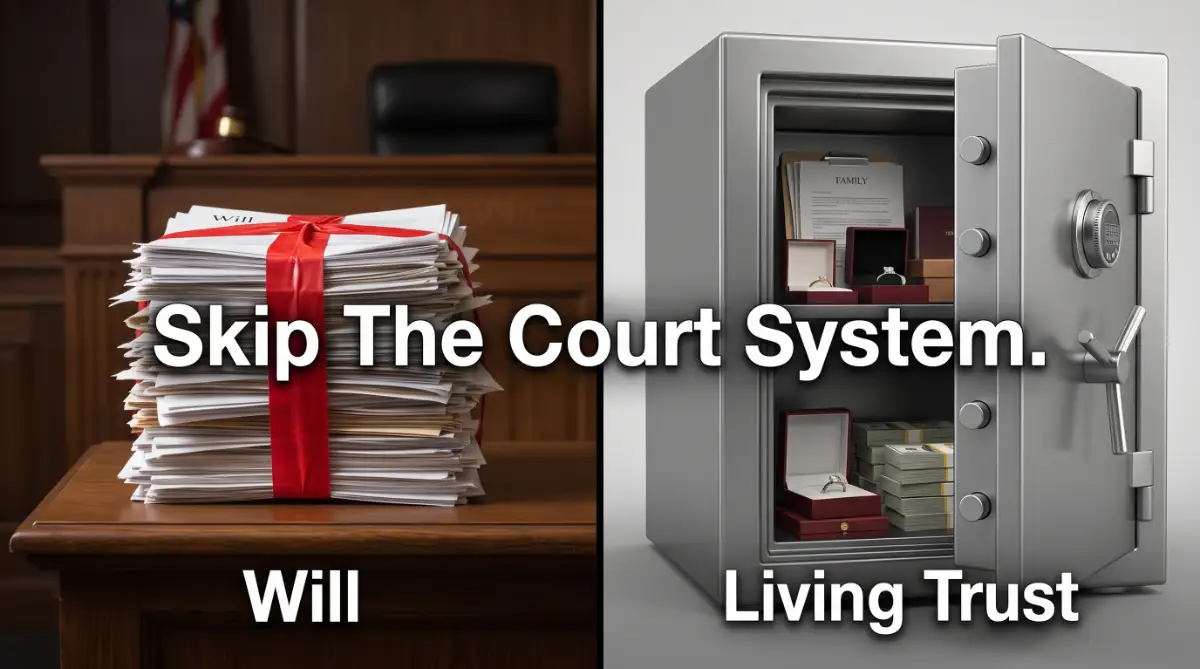
A living trust acts like a magical safe or a digital vault that you fully control while you are still alive and well. You put your house, your bank accounts, and your investments inside this safe, and you hold the only key. Because the safe technically owns your assets, there is absolutely no need for a judge to step in when you pass away.
Your hand-picked successor simply takes over the key and hands out the assets exactly as you instructed, usually within just a few weeks. This totally skips the public court system, saving your family a massive amount of stress and legal expenses.
Weighing the Pros and Cons of a Living Trust vs Will
Every financial tool has its strong points and weak points. When considering the last will vs living trust debate, you have to look at the immediate costs versus the long-term savings.
Setting up a basic document with your final wishes is usually very cheap and fast to do today. However, the true cost is simply passed down to your children later in the form of expensive legal fees.
On the other hand, creating a private vault requires more money and effort right out of the gate. You have to hire a smart professional to draft the paperwork and actually move your bank accounts over to the new system.
But the long-term payoff is massive because your family gets immediate, free access to your hard-earned money when they need it the most.
The Head-to-Head Comparison: Will vs Trust Chart
To make this extremely simple to digest, I have put together a clear breakdown. This simple will vs trust chart shows you exactly how these two common tools stack up against each other in real-life situations.
By looking directly at this comparison, the difference between living trust and a traditional will becomes incredibly obvious. One tool delays the process and exposes your life to strangers, while the other tool offers a smooth, private transition.
Making the Right Choice for Your Specific Situation
So, who needs a trust instead of a will anyway? If you own a house, have significant savings, or run a small business, you absolutely need to upgrade your strategy.
Families with special needs children or blended families from previous marriages also highly benefit from the strict control a private vault offers. It prevents bitter arguments because your rules are clearly locked in and cannot be easily challenged by unhappy relatives.
However, if you are extremely young, do not own any real estate, and only have a very small bank account, a simple document might be enough for now. You can always upgrade your strategy as your wealth grows and your family situation changes over time.
Addressing the Big Question: Which Route to Take?
Ultimately, when someone asks me which is better to have a will or a living trust, I always lean toward keeping things out of the courtroom. The temporary pain of doing some extra paperwork today is nothing compared to the massive headache your family will face later.
You spend your entire life working incredibly hard to put food on the table and build a comfortable life for your loved ones. Why would you risk letting a random judge decide how and when your family gets to survive?
Taking control of your own narrative is the most loving thing you can possibly do for your spouse and children. It completely removes the burden of legal guesswork from their shoulders during their darkest days.
Think of this strategy as the ultimate form of life insurance. It ensures that your protective blanket stays wrapped around your family long after you are physically gone. They will silently thank you for being so deeply organized and thoughtful about their future well-being. By making these smart moves today, you guarantee that your legacy is filled with love, fast transitions, and absolute financial security.
Mastering the Blueprint: Expert Strategies for Total Asset Control
Building your private family vault is only the very first piece of the puzzle. You might have the best legal paperwork in the world, but it means absolutely nothing if you do not know how to actually use it. Many smart people spend good money setting up these documents, only to leave them sitting in a drawer gathering dust.
To really understand how to protect family assets from probate, you must learn the secret of "funding" your new system. Think of your legal document as a brand-new, highly secure digital wallet. If you do not physically move your money into that wallet, the protection simply does not work.
You literally have to change the title of your house from your personal name to the name of your private vault. If you are a business owner, you also need to ensure your company shares are properly protected. Learning to carefully read and understand a legal contract ensures you do not miss these small but highly impactful details during the transfer phase.
People always ask me, what assets should be included in a trust? The answer is incredibly straightforward once you understand the core goal. You want to include your primary home, rental properties, standard bank accounts, and large non-retirement investment portfolios. You can even include valuable physical items like expensive artwork or high-end jewelry collections.
On the flip side, you need to know exactly what assets cannot be placed in a trust? You generally do not put your retirement accounts like an IRA or a 401(k) inside it, because moving those can trigger massive tax penalties.
Similarly, life insurance policies usually pass outside the court system automatically, as long as you named a living beneficiary on the actual policy forms.
When families start looking closely at their options, the financial aspect always takes center stage. You are likely wondering, how much does a living trust cost to set up properly? A standard living trust and a traditional will cost completely different amounts because they require different levels of professional work.
A basic piece of paper might cost you a few hundred dollars on a budget website. However, a comprehensive living trust attorney cost usually ranges from a few thousand dollars up to several thousand, depending on the complexity of your wealth. While that sounds like a big upfront number, it is incredibly cheap compared to giving away a huge percentage of your estate to the court system later.
It is absolutely fascinating to see how much does a living trust cost in USA, UK, Canada, and Australia because the legal fees vary widely by region. In America, you might pay anywhere from two thousand to five thousand dollars for a premium setup.
In the United Kingdom or Australia, the equivalent legal structures often run roughly similar amounts when converted, though the specific tax benefits look slightly different.
Protecting your true net worth from hidden mistakes means understanding these regional price differences. A good lawyer will actually save you ten times their fee by structuring things right the very first time.
You can read hundreds of Trust and Will reviews online, and you will quickly notice that the happiest families are the ones who paid for professional, personalized guidance instead of using cheap online templates.

Heartbreaking Legal Traps That Drain Family Wealth
Even the smartest people fall into massive legal holes simply because they do not understand how local laws actually work. It breaks my heart to watch grieving families lose their childhood homes because of a silly paperwork error. If you are researching this topic, you naturally want to know, what are the negatives to a trust vs will before you make a final choice.
The honest truth is that creating a private vault requires you to do a lot of administrative homework right now. What is the downside to a living trust for everyday people? It demands your time and attention to officially transfer your real estate deeds and update your bank account names.
If you buy a new piece of property a few years from now, you must remember to buy it under the name of your protected vault. If you forget, that specific house goes straight to the dreaded probate court.
The pain becomes even worse when you look at how different regions handle these mistakes. For example, comparing a living trust vs will in California, Texas, Florida, New York (USA States) shows massive differences in how courts treat your family. California and New York have some of the most incredibly expensive, slow, and frustrating court systems in the entire country.
If you live in those states and rely on a basic document, your family might wait over two years just to access your bank accounts. According to the American Bar Association guidelines on probate procedures, navigating these state-specific delays often forces families to hire multiple expensive lawyers just to keep things moving.
Meanwhile, looking at estate planning laws in Ontario, British Columbia (Canada Provinces) reveals a different kind of trap. Provinces like Ontario have hefty probate taxes based directly on the total value of your assets.
Families end up writing massive checks to the government before they can even touch their inheritance. Skipping the local court system there is not just about saving time; it is about keeping your actual cash safe from heavy taxes.
You will find similar unique rules when exploring UK estate planning: Difference between a will and a trust in England & Scotland. The specific way property passes to a spouse in Scotland varies greatly from the rules in England. The UK Government's official guidance on inheritance clearly outlines how minor technicalities can entirely change who gets your money.
The story is just as complicated down under. When people ask which is better in NSW, Victoria, Queensland (Australia States), a will or a trust?, the answer deeply depends on family dynamics. Australian courts are very strict about dependents challenging the final wishes. A poorly drafted document leaves your entire estate open to aggressive lawsuits from unhappy relatives.
No matter where you live, you must adapt to the specific estate planning laws in [Specific State/Province Name]. Trying to guess the rules on your own is one of those hidden legal traps that destroy hard-earned money.
Instead of guessing, you should actively search for a qualified asset protection trust lawyer who understands your exact local jurisdiction. Do not wait for a medical emergency to suddenly start searching for an estate planning attorney near me on your phone.
Real Questions Families Ask Before Signing
Do I lose control of my money if I put it in a private vault?
Absolutely not. As long as you choose a "revocable" structure, you remain in total command of every single penny. You can sell your house, spend your cash, or completely cancel the entire legal setup whenever you want.
Can I manage my digital assets like crypto and online businesses this way?
Yes, you certainly can and absolutely should include your digital life. Learning to secure your digital assets properly means passing down your login credentials and private keys through your legal paperwork so nothing gets lost in the cloud.
Is it really necessary if I am young and perfectly healthy?
Tragedy never asks for your permission before it strikes. Getting your basic structure in place now acts just like a strong financial emergency fund. It gives your spouse or partner immediate access to your shared life if you suddenly end up in the hospital.
Does this strategy hide my money from the government or legal creditors?
No, a standard revocable structure does not magically erase your personal debts or hide your money from legitimate taxes. If you owe money while you are alive, your creditors can still reach those funds. However, the National Consumer Law Center offers great insights on how specific advanced, irrevocable structures can sometimes offer deeper asset shielding.
Your Next Steps Toward Total Financial Peace
Taking the time to organize your life's work is one of the most generous gifts you can ever give your family. You are completely removing a massive burden of stress, confusion, and expensive legal battles from their shoulders. The true purpose of understanding these legal tools is to ensure your loved ones are emotionally and financially safe when life gets incredibly tough.
Instead of leaving a messy pile of paperwork for your children to figure out, you are leaving them a clear, actionable map. You are guaranteeing that the money you worked so hard to save actually goes directly to the people you love.
The initial cost and the temporary effort of filling out some forms pale in comparison to the absolute peace of mind you gain today.
I look back at my own family's painful court experience and clearly realize how easily we could have avoided all those sleepless nights. Taking action today by setting up your protective vault is not just about managing money; it is about wrapping a permanent blanket of love and security around your family’s future.
Disclaimer: The information provided in this article is for educational and informational purposes only and does not constitute professional legal, tax, or financial advice. Estate planning laws change frequently and vary significantly by jurisdiction. Always consult with a licensed and qualified estate planning attorney or financial advisor in your specific state or country before making any major legal or financial decisions regarding your assets.
![7 Hidden Legal Traps That Can Bankrupt Your Small Business Overnight [Avoid These!]](https://nexvoramag.com/storage/uploads/blogs/1787550945_7-hidden-legal-traps-that-can-bankrupt-your-small-business-overnight-avoid-these.webp)