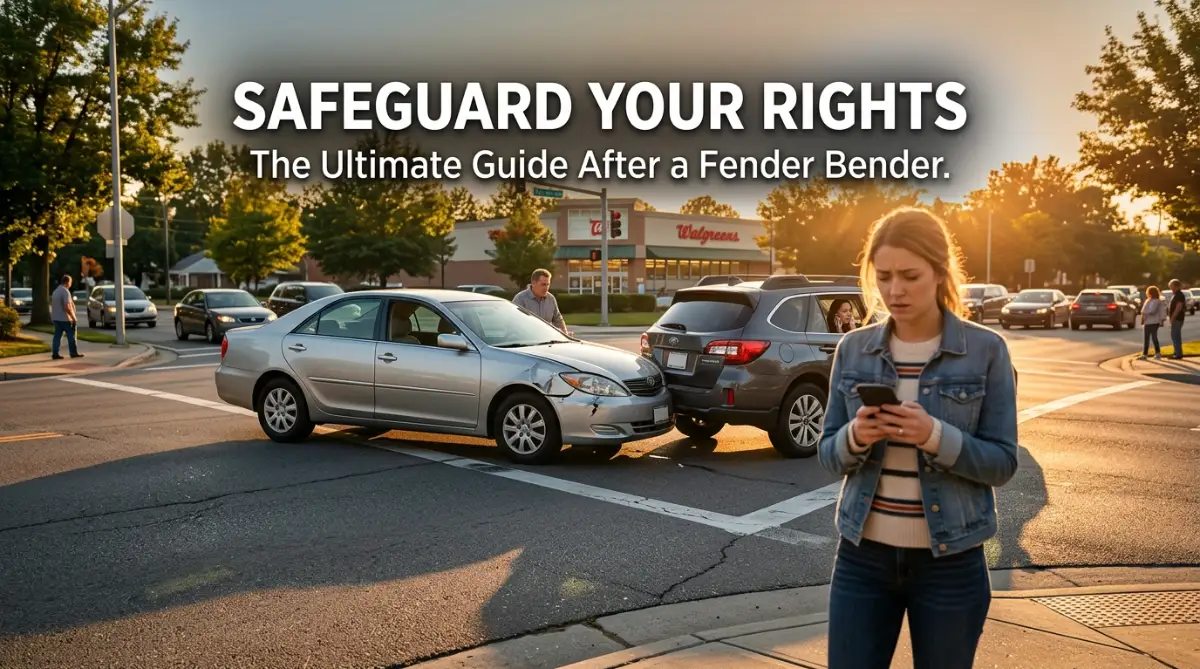
The Day My "Small Bump" Turned Into a Massive Headache
Your heart is racing, your hands are shaking, and you are standing on the side of a busy road looking at a small dent in your car. Most people think, 'It’s just a scratch, I can handle this later,' but that one thought is exactly how insurance companies win and you lose.
A minor fender bender can quickly turn into a legal nightmare if you don't play your cards right in the next ten minutes. I’ve lived through this headache, and I’m going to show you exactly how to protect your health and your bank account before it's too late.
At first, I thought, "It's just a scratch, no big deal." The other driver was polite, and I just wanted to go home and relax. I almost told him not to worry about it. My brain was telling me to be the "nice guy" and just drive away because there was no blood and no broken glass.
That was my first mistake, and it almost cost me thousands of dollars. I didn't realize that a minor dent is often the tip of a very expensive iceberg.
My neck started stiffening up two days later, and my insurance company started asking questions I wasn't ready to answer. I felt trapped in a confusing web of paperwork and legal talk.
It feels lonely when you are standing on the side of the road, shaking a little, and trying to figure out what to say. You worry about your insurance rates going up. You worry about being sued.
This stress can keep you awake at night, wondering if you signed something you shouldn't have or if you said too much to the other driver.
I want to help you avoid that sinking feeling in your stomach. You don't need to be a lawyer to protect yourself, but you do need a plan. Let’s look at how you can handle these "minor" situations with total confidence and keep your rights safe.
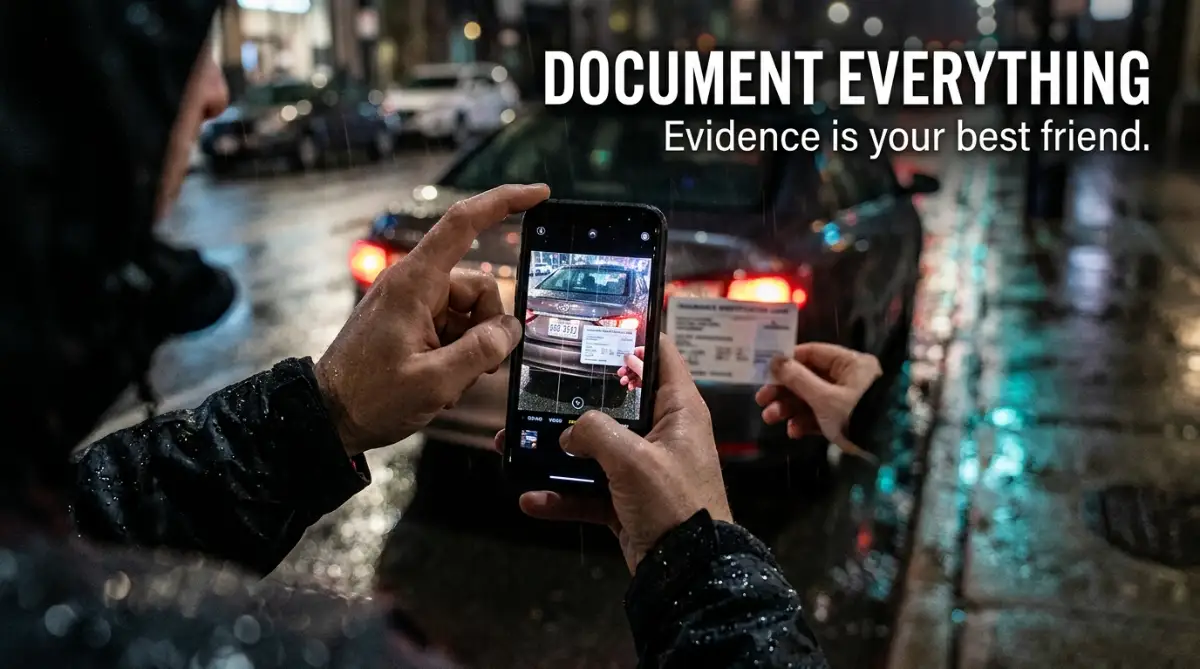
🚨 Quick Safety & Rights Checklist
- Never Say Sorry: Politeness can be used as an admission of fault in court.
- Snap 20+ Photos: Document plates, IDs, and the entire street layout immediately.
- See a Doctor Fast: Get a medical record within 24 hours to prove hidden injuries.
- Police Reports Matter: Even for small dents, a third-party report is your strongest shield.
- Avoid Fast Cash: Never sign a settlement check until you know the full cost of repairs and health.
The Instant Action Plan: What to Do Before You Even Move Your Car
When that impact happens, your adrenaline spikes. This is a natural "fight or flight" response, but it can make you forget the simple things. The very first thing you must do is breathe. Don't jump out of the car and start shouting or apologizing.
Stay in your vehicle for a moment. Check your body. Does anything feel "weird"? Sometimes a tiny bit of shock hides a lot of pain. Once you know you can move, turn on your hazard lights.
This is about safety first. You don't want a minor bump to turn into a major pile-up because other drivers can't see you.
The Danger of Saying "I'm Sorry"
This sounds strange because we are taught to be polite. However, in the world of insurance and law, "I'm sorry" can be used as an admission of fault. Even if you think you might have stopped too fast, do not apologize.
Instead, stick to the facts. Ask the other person, "Are you okay?" or "Is everyone in your car safe?" This shows you are a responsible human being without handing over your legal rights.
I once saw a friend lose a claim because he said "Sorry about that" right after a crash, and the insurance company claimed he admitted guilt.
Building Your Wall of Evidence
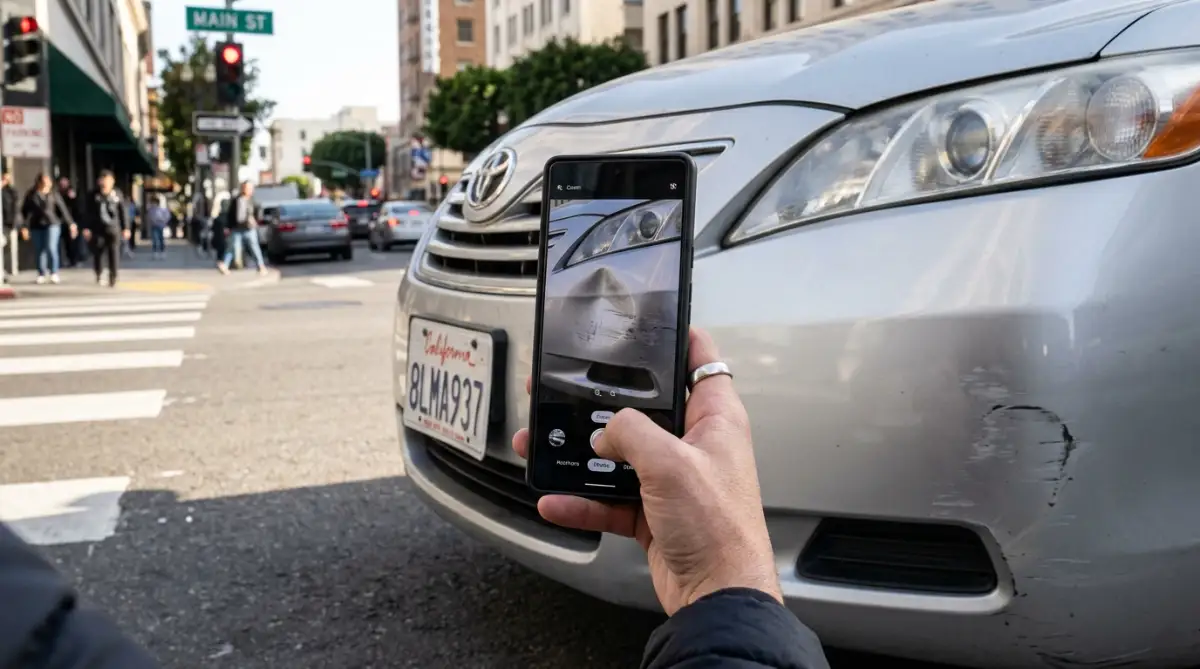
You have a high-tech tool in your pocket: your smartphone. Use it immediately. Most people take one photo of the dent and stop.
That is not enough. You need to tell a story with your camera so the insurance company can't argue with you later.
Take photos of the entire scene. Show the street signs, the skid marks on the road, and the position of both cars. Get shots from far away and close up.
Make sure you get a clear photo of the other person's license plate. Drivers sometimes give fake names or old insurance cards, but a plate number is tied to a real person.
I once forgot to take a photo of the street lights during a small crash. Later, the other driver claimed the light was green for them. Because I didn't have a photo showing the layout of the intersection, it became my word against theirs. Don't make that mistake. Take more photos than you think you need.
| What to Photograph | Why It Matters |
| Wide Angle of the Scene | Shows traffic lights, signs, and road conditions. |
| Close-up of Damages | Proves the exact impact spot so no new 'old' damage is added. |
| The Other Driver's ID | Ensures you have their legal name and address. |
| Witness Contact Info | Their neutral story can save your case if the other driver lies. |
| Weather/Skid Marks | Proves if someone was speeding or if the road was slippery. |
The "Invisible Injury" Trap You Must Avoid
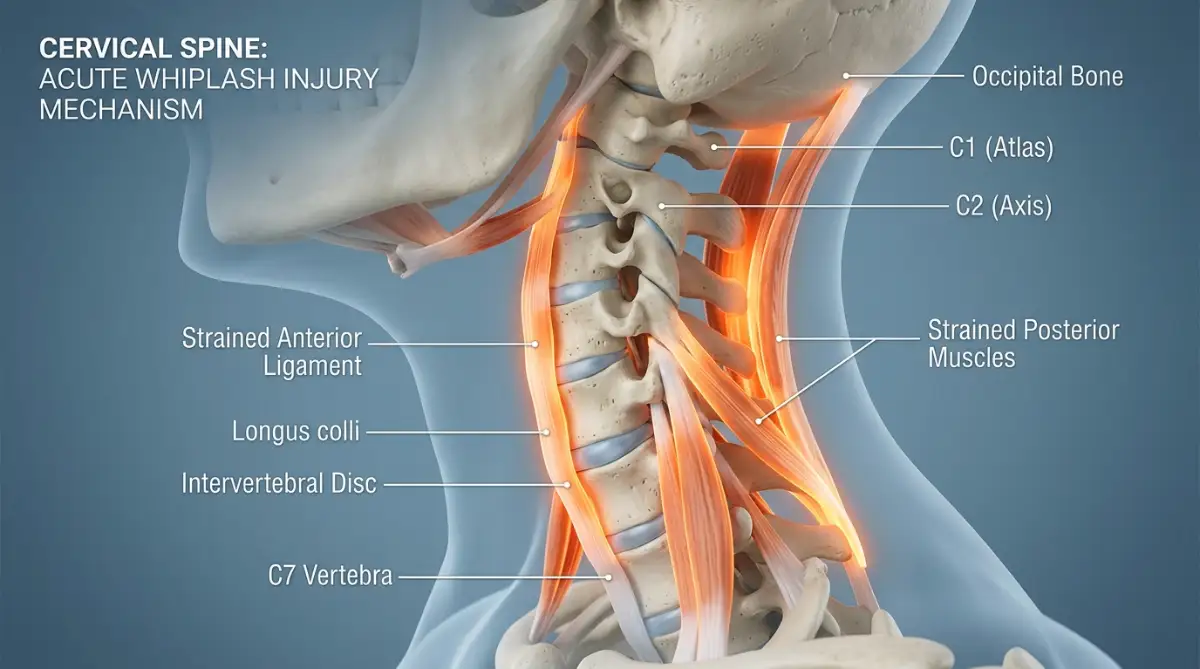
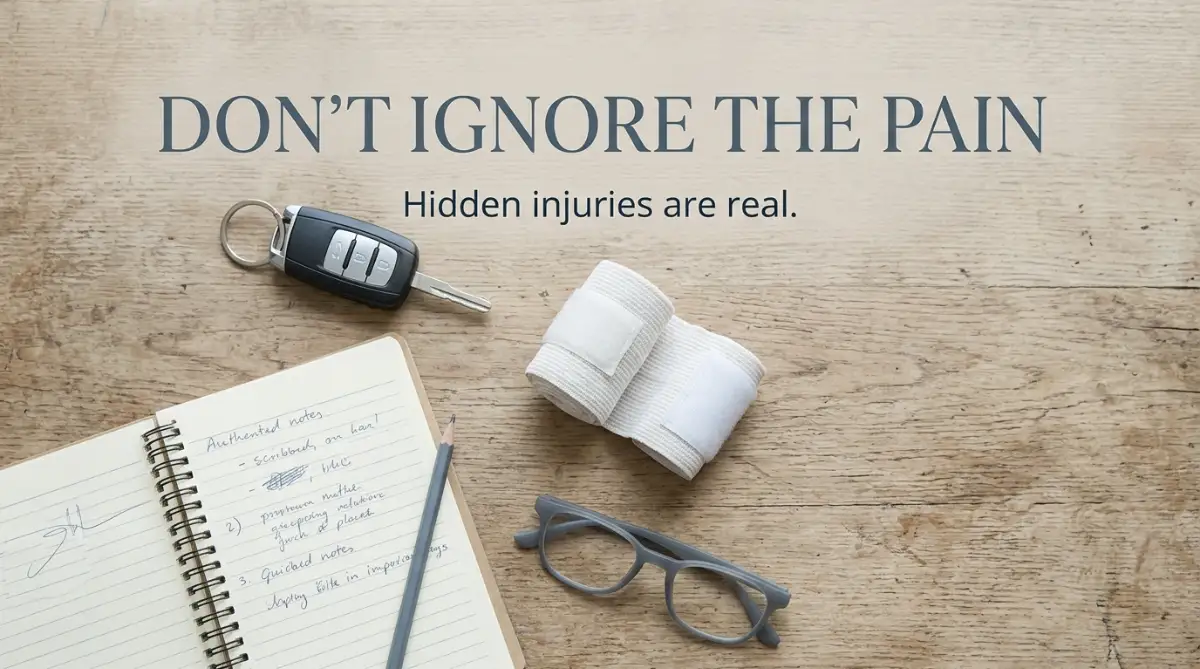
The most dangerous part of a minor accident isn't the car damage; it's what happens inside your body. High-speed crashes are obvious, but low-speed crashes create something called "whiplash." Your head snaps back and forth, and your soft tissue gets tiny tears.
You might feel "fine" at the scene. This is because your body is pumping out adrenaline and endorphins to keep you moving. This is a survival trick. But when those chemicals wear off—usually 24 to 48 hours later—the pain arrives.
Pro Tip: Even if you feel okay, go to a quick-care clinic or your regular doctor within 24 hours. I used to think this was "overreacting" until I woke up three days after a bumper-tap unable to turn my head.
Having a medical record from the day after the crash is the only way to prove the injury came from the accident. If you wait a week, the insurance company will claim you got hurt at the gym or while sleeping.
Watch this short video to understand how even low-speed impacts can affect your spine and your legal claim.
[How Low-Speed Crashes Impact Your Body and Claims]
Winning the Conversation with Insurance Adjusters
Soon after the crash, you will get a phone call. The person on the other end will sound very friendly. They will ask, "How are you feeling today?" Most of us reflexively say, "I'm doing good, thanks."
Stop right there. If you say "I'm good," they will write down in their file that you are not injured. This is a classic tactic.
When an adjuster calls, you have to remember they are working for a business that wants to save money. They are not your personal friends.
The "Recorded Statement" Warning
The adjuster might ask to record the call to "get your side of the story." You are often not legally required to do this immediately. You have the right to tell them, "I am not ready to give a recorded statement until I have reviewed my notes and spoken with my doctor."
Give yourself time to think. Write down exactly what happened while it is fresh in your mind. If you give a statement while you are stressed or tired, you might say something slightly different than what you told the police. Insurance companies love to find these tiny differences to deny your claim.
Myth: If the car looks fine, I don't need to see a doctor.
Reality: Soft tissue damage (like whiplash) can take 48 hours to show symptoms. A doctor’s visit on day one creates a paper trail that insurance companies cannot argue with.
Myth: I have to accept the insurance company's first repair offer.
Reality: You have the right to ask for a 'Diminished Value' claim, which covers the loss of resale value because your car now has an accident history.
Understanding "Total Loss" vs. "Repairable"
Sometimes, a minor accident can "total" an older car. This happens when the cost to fix the bumper and sensors is more than what the car is worth. Don't let the insurance company give you a low-ball offer.
Do your own research. Look up what your car was selling for in your local area before the crash. If they offer you $2,000 but you can see that same car costs $4,000 to buy today, you have the right to show them that data. I helped a neighbor get an extra $1,500 just by showing local listings to the insurance company.
Why a Police Report is Your Golden Ticket
Many people think that if the damage is under $500, they don't need to call the police. This is a huge risk. In many places, the police won't come for a "fender bender," but you can still go to the station and file a report yourself.
A police report is an unbiased, third-party document. It records the weather, the time, and the statements of both drivers. Without this, the other driver can change their story the next day.
I've seen people be very nice at the scene and then tell their insurance company a total lie 24 hours later. A police report makes it much harder for them to lie.
Key things to check in a report:
- Correct spelling of names.
- The exact location of the crash.
- Any mention of traffic violations (like the other person following too closely).
If you see a mistake in the report, ask for it to be corrected immediately. This document is often the most important piece of paper in your entire legal journey.
Navigating the Maze of "No-Fault" vs. "At-Fault" States
Depending on where you live, the rules for your "rights" change completely. In a "No-Fault" state, your own insurance pays for your medical bills regardless of who caused the crash. In an "At-Fault" state, the person who caused the accident is responsible for everything.
This can be incredibly confusing. If you are in a No-Fault area, you might think you can't sue the other person. However, if your injuries are serious enough or your bills go over a certain limit, you might still have the right to take legal action.
Protecting Your Future Financial Health
A minor car accident can have "long-tail" effects. Your insurance premiums might try to creep up. Your car's resale value will drop because it now has an "accident history" on reports like Carfax. This is called "Diminished Value."
Most people don't know they can sometimes claim for this lost value. If your car was worth $20,000 before the crash and now it's only worth $17,000 because of the accident history, that $3,000 is a real loss.
I once helped a cousin realize that just getting the bumper fixed wasn't enough. He needed to be compensated for the fact that his car was now harder to sell in the future. Always think about the long-term money, not just the check for the body shop.
Winning the Long Game: Smart Strategies for Your Car and Your Wallet
Moving forward after a small crash isn't just about fixing a dent. It is about making sure you don't pay for someone else’s mistake for years to come. One of the best things you can do is understand the "Diminished Value" of your vehicle.
Even if your car looks brand new after the repair shop is done, its history is now stained. When you go to sell it, a buyer will see that it was in an accident.
This makes your car worth less than a similar car with a clean record. You have the right to ask for a "diminished value claim" from the at-fault driver's insurance.
I once helped a friend realize his car lost $2,000 in resale value because of a simple fender bender. He didn't even know he could ask for that money.
Most insurance companies won't tell you about this because they want to keep that cash in their pockets. You have to be the one to bring it up.
Another pro secret is knowing when to stop talking to your own insurance company. While you have to report the accident, you don't have to accept their first choice for a repair shop.
Many people feel pressured to use the "preferred" shop. These shops often use cheaper, non-factory parts to save the insurance company money.
You should always look for a shop that uses Original Equipment Manufacturer (OEM) parts. This ensures your car remains safe and holds its value.
If you want to dive deeper into how insurance rules work, you should check out why comprehensive car insurance is essential for every vehicle owner. It explains a lot about what you are actually paying for every month.
The Hidden Power of Your Medical Records
Even if you only have a small headache, keep a "pain journal." Write down how you feel every morning for two weeks. This might sound like a lot of work, but it is pure gold if your case goes to court or a high-level settlement.
If you say, "My back hurts," it’s a vague claim. But if you say, "On Thursday morning, I couldn't lift my grocery bags," that is a specific fact. Legal experts at Law.com often mention that specific, documented life impacts are much harder for insurance companies to ignore.
You should also be very careful about your health insurance. Sometimes, your health provider might try to refuse payment, saying the car insurance should pay first.
This can lead to your bills going to collections while the two companies argue. To avoid this, you need to understand how to choose the right health insurance coverage for your family needs and how it overlaps with your car policy.
Managing Your Digital Footprint After a Crash
In our modern world, your phone can be your worst enemy after a crash. Insurance adjusters are trained to "creep" on your social media profiles. If you claim your neck is stiff but then post a photo of you dancing at a party, they will use that to deny your claim.
It doesn't matter if you were "pushing through the pain" to be with friends. The photo tells a different story to a judge. My advice is to go completely dark on social media until your claim is settled. Don't post about the accident, and don't post about your daily life.
This is part of a larger need to secure your digital assets and your private life. Keeping things private is a form of legal protection. If the insurance company can't find a reason to doubt you, they are much more likely to pay you fairly.
The Role of Technology in Your Defense
If you don't have a dashcam yet, get one today. A dashcam is like having a silent witness that never lies and never forgets. It can prove that the other driver didn't use their turn signal or that they were drifting into your lane.
The National Highway Traffic Safety Administration (NHTSA) provides great data on how most accidents are caused by human error. A video of that error makes your legal path much smoother. It takes the "he-said, she-said" out of the equation.
The Expensive Mistakes That Can Ruin Your Peace of Mind
The biggest trap people fall into is the "Fast Cash" trap. An insurance company might call you three days after the accident and offer you a check for $500. They will say it’s for "pain and suffering" and that they will still pay for the car repairs.
It sounds like a great deal when you are stressed about money. But once you sign that paper and cash that check, your legal rights are usually gone forever.
If your neck starts hurting six months from now and you need surgery, you can't go back and ask for more.
I have seen people lose out on tens of thousands of dollars because they wanted a quick $500 to pay a credit card bill. If you are struggling with money, it is better to look at how to increase your credit score rapidly rather than trading away your legal safety net for a tiny check.
The "I Don't Need a Lawyer" Assumption
You might think that because the accident was small, a lawyer won't talk to you. That is not true. Many personal injury lawyers offer free consultations. They can tell you in ten minutes if you are being cheated.
Even if you don't hire them, that ten-minute talk can give you the confidence to stand your ground. Don't let the fear of "legal fees" stop you from getting expert advice. Often, these lawyers only get paid if they win more money for you than you were already offered.
You also need to be careful about "fake" help. After a crash, you might get weird calls or mail from people promising you "free money" or "emergency help." You must learn how to protect your money from fake loan and insurance offers so you don't get scammed while you are already vulnerable.
Ignoring the Fine Print
When you finally get a settlement offer, read every single word. Insurance companies use very specific language to limit what they are paying for. They might say they are paying for "medical expenses" but not "future care."
If your doctor says you need physical therapy for a year, but the check only covers this month, you are in trouble. Just like when you read website terms of service and privacy policies, you have to look for the "gotcha" clauses.
If you don't understand a word, look it up or ask someone you trust. Never sign something because you feel "rushed." The adjuster's job is to make you feel rushed. Your job is to be slow, careful, and smart.
Taking Control of Your Recovery and Your Future
Handling a car accident is a marathon, not a sprint. It takes patience to deal with the phone calls, the body shops, and the doctors. But if you stay organized, you will come out on top.
Keep a folder—either a physical one or a digital one—with every single receipt, email, and photo related to the crash.
This folder is your shield. If someone tries to say you are lying, you can open that folder and show them the truth. Being organized is the best way to stay calm and think clearly under pressure. When you have the facts in front of you, the "legal maze" doesn't seem so scary anymore.
I want you to know that you are stronger than this situation. A small car accident is a bump in the road, not the end of the road. By following these steps, you are protecting your car, your health, and your hard-earned money.
I’ve seen so many people let these small moments grow into giant life problems. My goal is to make sure that doesn't happen to you. Take a deep breath, follow the plan, and don't be afraid to ask for what you deserve. You’ve got this!
Common Questions About Minor Car Accidents
Do I have to call the police if there is no damage?
It is always a good idea to at least try to get a report. Even if the cars look fine, internal sensors or frame parts might be broken. A police report acts as a factual anchor so no one can change their story later.
Can I use my own mechanic for the repairs?
Yes, in almost every state, you have the right to choose your repair shop. The insurance company might suggest their "partners," but you should pick the shop you trust the most. Make sure they use high-quality parts that match your car's original build.
How long do I have to file a claim?
This depends on your local laws, often called the "statute of limitations." In some places, you have two years, and in others, it’s much shorter. The best rule is to start the process within 24 hours so you don't miss any deadlines.
What if the other driver doesn't have insurance?
This is where your "Uninsured Motorist" coverage comes in. Your own insurance will step in to pay for your damages. If you don't have this coverage, you might have to look into getting emergency financial assistance to cover immediate costs while you figure out a legal plan.
Disclaimer: The information provided in this article is for educational purposes only and does not constitute professional legal advice. Laws regarding car accidents and insurance vary significantly by location. Always consult with a qualified attorney in your area for specific legal guidance tailored to your situation. This website is not responsible for any actions taken based on this content.
![Stop Content Thieves! How to Lock Down Your Digital Property [Step-by-Step]](https://nexvoramag.com/storage/uploads/blogs/1785996313_stop-content-thieves-how-to-lock-down-your-digital-property-step-by-step.webp)