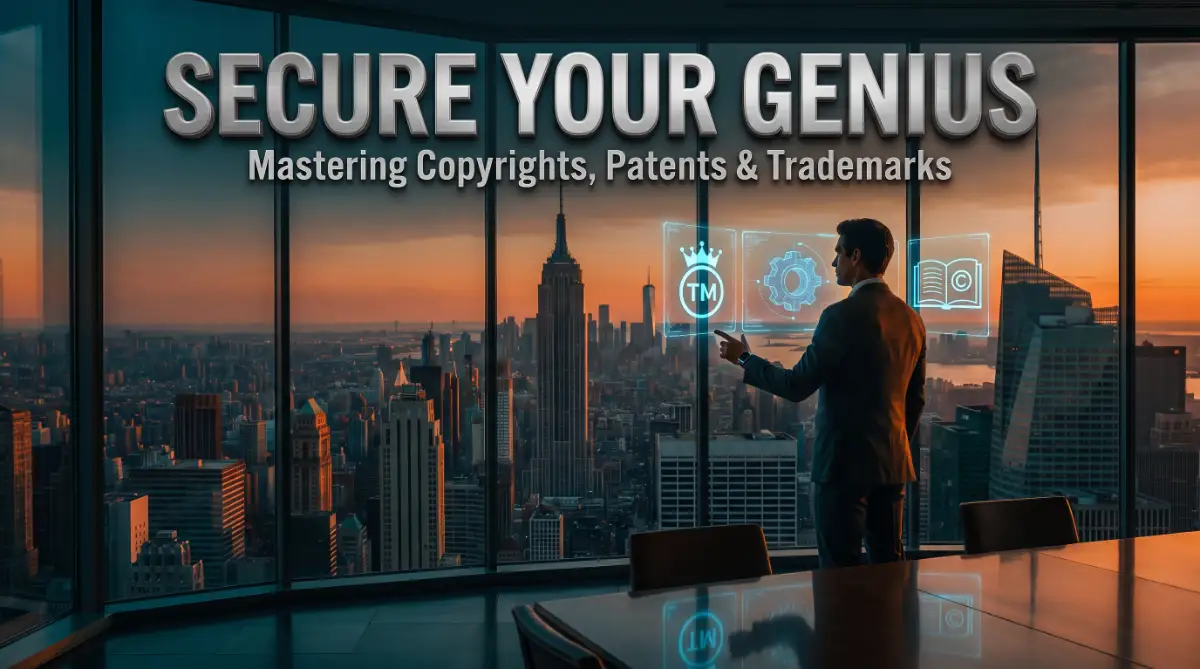
I remember exactly how it felt when I saw my first big project being sold by someone else on the other side of the country.
I had spent countless late nights and skipped so many weekends to build that brand, only to watch a stranger profit from my hard work. It made me feel completely helpless, like my best ideas weren't actually mine anymore.
That painful experience taught me that being creative isn't enough; you have to know how to build a shield around your dreams.
The Heartbreak of Watching Your Ideas Get Stolen
You spent months, maybe even years, building something special. It started as a tiny spark in your mind and turned into a real business, a beautiful book, or a clever invention.
But then, you see it. Someone else is using your name, selling your product, or copying your words.
The feeling is like a punch to the gut. You feel cheated, angry, and honestly, a little bit scared. You want to fight back, but you don't know where to start. Is it a copyright issue? Do you need a patent? Or is a trademark the answer?
Most people feel completely lost when they try to find these answers. They search online and find long articles filled with boring legal talk.
It feels like you need a law degree just to understand the first paragraph. This confusion keeps you stuck.
- You might follow "free" advice from social media that is actually wrong.
- You might spend money on the wrong type of legal filing and lose it all.
- You might wait too long to act, and then it’s too late to stop the copycats.
- The fear of making a mistake keeps you from doing anything at all.
This constant worry eats away at your mental peace. You can't focus on growing your business because you're too busy looking over your shoulder.
It feels like you are building a house on sand. Without the right legal walls, anyone can come and knock it down.
You deserve to feel confident and secure in your work. You should be able to tell the world about your brand without being afraid. That is why we wrote this guide.
We want to take the "scary" out of legal rights and give you a clear map to follow.

The Simple Guide to Protecting Your Genius
Before we dive into the specific differences, let's look at the big picture. Think of these three things like different types of locks for your house. You wouldn't use a bike lock on your front door, right?
In the same way, you need the right tool for the right job. Let's break down these seven key differences so you never have to guess again. We will keep it simple, just like we are talking over a cup of coffee.
1. What exactly are you protecting?
The biggest difference is the "stuff" you want to save. A copyright is for creative things. Think about the things you write, draw, or record. This includes blog posts, songs, movies, and even the code for a website.
A trademark is all about your brand's identity. This is how customers find you in a crowded market. It covers your business name, your logo, and even your catchy slogan. It tells people, "This product came from this specific company."
A patent is for inventions and functional designs. If you created a new type of coffee machine or a special way to fold a cardboard box, that’s a patent. It’s about how something works or how it is made. It’s for the "engine" of your idea, not just the "paint."
2. Who owns the rights by default?
This is where many people get a happy surprise. With a copyright, you own it the second you create it. As soon as you finish writing that poem or snapping that photo, it is legally yours. You don't have to do anything else to have basic rights.
Trademarks are a bit different. You get some rights just by using the name in business. This is called a "common law" trademark. However, these rights are limited and only apply to your local area. To get real protection, you have to register it.
Patents are the strictest of the bunch. You own nothing until the government says you do. There is no such thing as an "automatic patent." If you don't file the paperwork and get it approved, anyone can legally copy your invention.
3. How long does the protection last?
Nothing lasts forever, but some protections last longer than others. Copyright is the long-distance runner. For most people, it lasts for their entire life, plus an additional 70 years after they pass away. Your grandkids can still benefit from your work!
Trademarks can technically last forever. As long as you are still using the brand name and you keep paying the renewal fees every 10 years, it’s yours. Companies like Coca-Cola have kept their trademarks for over a century.
Patents are the short-distance sprinters. Most patents only last for 20 years. After that, your invention goes into the "public domain." This means anyone can make it. This is why medicines become much cheaper after the patent runs out.
4. What is the main goal of the law?
Laws are made for specific reasons. The goal of copyright is to encourage people to create art and stories. The government wants you to write books, so they give you the right to make money from them.
The goal of a trademark is to protect the consumer (the person buying the stuff). It’s there so you don't accidentally buy "Nke" shoes when you wanted "Nike." it prevents confusion in the marketplace.
The goal of a patent is to push technology forward. The government gives you a monopoly for a few years as a reward for your smart idea. In return, you have to share exactly how your invention works so others can learn from it later.
5. Is the registration process easy or hard?
Registering a copyright is very simple and cheap. You can do it online in a few minutes. It’s like sending an email. Most people can do this themselves without a lawyer.
Registering a trademark is a bit harder. The government has to check if your name is too similar to someone else's. It takes several months, and it’s easy to make a mistake on the forms. Many people hire a professional to help.
Registering a patent is the hardest level. It is very expensive and can take years. You have to provide detailed drawings and technical data. It is almost impossible to do this correctly without a specialized patent lawyer.
If you’re still feeling a bit unsure about the steps, watch this helpful video that breaks down these legal tools in plain English. It’s a great way to see how these rules work in real life before you finish reading the rest of our guide!
6. Common Myths vs. Reality
Let's clear up some things that people often get wrong.
- Myth: I can just mail a letter to myself to get a "Poor Man's Copyright."
- Reality: This does not hold up in court. If you want to sue someone, you need a real registration.
- Myth: If I change 10% of someone's logo, it's not a trademark violation.
- Reality: If it still confuses the customer, you are in trouble. There is no "magic percentage."
- Myth: I have a patent, so the government will stop people from stealing my idea.
- Reality: The government just gives you the right to sue. You have to be the one to find the thieves and take them to court.
7. What happens if someone steals it?
If someone steals your copyrighted work, you can ask a judge to make them stop. You can also ask for money for the damages they caused. If you registered early, you might even get "statutory damages," which can be a lot of money.
If someone uses your trademark, you have to prove that customers are getting confused. You can force them to change their name or logo. Often, the court will make them give you all the profit they made using your brand.
If someone steals your patented invention, the legal battle is usually very big. Because patents are about technology, these cases often involve "experts" and lots of testing. It is a long and expensive process, but the rewards can be millions of dollars.
Real-Life Scenario: The Story of "Healthy Sips"
Imagine a woman named Sarah. She starts a business selling a special organic tea.
- She writes a beautiful book about tea recipes. (Copyright)
- She names her company "Healthy Sips" and creates a green leaf logo. (Trademark)
- She invents a new type of tea bag that steeps 50% faster. (Patent)
If Sarah only gets a copyright for her book, someone could still steal her logo and her tea bag idea. She needs all three to be fully safe. If she only protects her name, someone could copy her recipes.
This is why understanding the differences is so important. You don't want a "hole" in your legal shield. By knowing which tool to use, Sarah can grow her tea business without any fear.
One of the biggest mistakes I made early on was thinking I needed a fancy law degree or thousands of dollars just to get started. I stayed paralyzed by fear for months because I thought the legal world was only for big corporations.
My real "aha" moment came when I realized I could handle the basics myself for a fraction of the cost. Don't wait until you're a "big shot" to protect your work—securing even one small piece of your business today can save you from a massive headache next year.
Pro Tip: Start with the "Low Hanging Fruit"
If you are on a budget, start with Copyright. It is the cheapest and easiest. Next, look at Trademarks for your brand name. These two will cover most of what a small business owner needs.
Only go for a Patent if your invention is truly unique and the "secret sauce" of your success.
We hope this helps you feel more in control. Your ideas are valuable, and they deserve to be protected. In the next part of this guide, we will look at exactly how to file these documents yourself to save even more money.
Smart Ways to Keep Your Ideas Safe for Life
Now that we have covered the basics, let’s talk about how the pros handle their business. Protecting your work is not a "one-and-done" task.
It is a habit you need to build. Most people think they can just file a paper and forget about it. That is a huge mistake.
To truly keep your ideas safe, you need to think like a bodyguard for your brand. This means looking at your work from every angle.
You want to make it so difficult for thieves to copy you that they just give up. Let’s look at some advanced ways to do exactly that.
The Layered Protection Strategy
Have you ever seen an onion? It has many layers. If you peel one away, there is another one underneath. Your legal protection should be exactly like that. We call this "Layered Protection."
Let’s say you are building a new software app. You don't just stop at a trademark for the name. You also need to look at how to carefully read and understand a legal contract before signing with your developers. This ensures they don't walk away with your code.
You should also copyright the actual code of the app. If there is a unique feature that has never been seen before, you might even look into a patent.
By using all three tools together, you create a shield that is almost impossible to break. This is how big tech companies stay on top. They don't just use one lock; they use ten.
Building a Paper Trail That Wins in Court
Imagine you go to court because someone stole your design. The judge asks, "How do I know you created this first?" If you just say "I remember doing it," you will probably lose. You need proof.
Expert creators keep a "design diary" or a digital log. Every time you have a new idea, write it down. Save the early sketches. Keep the timestamps on your computer files. This is called a paper trail.
If you are working on a big project, you might want to look into how to secure your digital assets using hardware wallets and cold storage for your most sensitive design files.
Keeping your files safe from hackers is just as important as keeping them safe from legal thieves.
The Power of "Public Notice"
You don't always need a lawyer to start protecting yourself. You can start today by using symbols. Have you seen the little © or ™ symbols? These are not just for show. They tell the world, "Hey, I know my rights, so don't touch this."
Using the ™ symbol doesn't cost a penny. You can put it next to your brand name right now. It shows you are claiming that name as your own. The © symbol for copyright is the same.
You should put it at the bottom of your website or on the first page of your book. According to the U.S. Copyright Office, this simple act can sometimes stop a thief before they even try to copy you.
How to Audit Your Own Work
Every six months, you should sit down and do a "Legal Checkup." Look at everything you have created. Ask yourself these questions:
- Have I created a new logo or brand name lately?
- Did I write a major piece of work that isn't protected?
- Is my patent about to expire?
Doing this checkup helps you catch holes in your shield. It’s a lot like how to validate your small business idea before launching to the public.
You want to find the problems while they are small and easy to fix. If you wait until someone steals your work, the fix will be much more expensive.
Steer Clear of These 5 Expensive Legal Traps
Even smart people make mistakes when it comes to legal stuff. These errors can cost you thousands of dollars and years of stress. Let’s look at the most common pitfalls so you can skip them.
1. The "Wait and See" Mistake
Many people wait until their business is famous to file for a trademark. This is a disaster waiting to happen. Someone else could register your name while you are waiting.
If that happens, they could legally force you to change your name. Imagine having to throw away all your business cards and signs because you waited too long.
2. Using a Name That is Too Simple
You cannot trademark words that just describe a product. For example, you can't trademark the name "Tasty Apple" for an apple company. Why? Because other people need those words to describe their own apples.
Pick a name that is unique or even a "made-up" word. Made-up words are the strongest trademarks because nobody else is using them.
3. Forgetting the "Work for Hire" Rule
If you pay someone to design a logo for you, who owns it? You might think you do, but the law says the artist owns it unless you have a written contract.
Always make sure you have a paper that says the rights belong to you. Without this, you might find yourself in a nasty battle with a freelancer later on.
4. Sharing Your Invention Too Early
This is a huge trap for inventors. If you talk about your invention in public or on social media before filing for a patent, you might lose your right to get that patent.
The law says your idea must be "new." Once it’s on the internet, it’s not a secret anymore. Always keep your mouth shut until the paperwork is filed.
5. Not Checking the Competition
Before you fall in love with a name, search for it. Look on Google, check social media, and search the USPTO database. If someone else is already using a similar name, don't try to fight them.
It’s better to change your name now than to get a "Cease and Desist" letter six months from now.
The Hidden Cost of Ignoring Legal Safety
If you ignore these rules, you aren't just risking a name. You are risking your entire future. A legal battle can drain your bank account and ruin your reputation.
It’s a lot like why people say stop losing files: the easy system that actually works. You don't realize how important it is until everything is gone.
Think of legal protection as an insurance policy. You hope you never have to use it, but you will be so glad you have it if things go wrong. It gives you the "legal teeth" to bite back when someone tries to take what belongs to you.
Your Roadmap to Peace of Mind
You have learned a lot today. You now know more about copyrights, patents, and trademarks than 90% of business owners. But knowledge is only powerful if you use it.
Don't let this information just sit in your head. Take one small step today. Maybe that step is adding a copyright symbol to your website.
Maybe it’s searching for your business name to see if someone else is using it. Whatever it is, do it now.
The 24-Hour Protection Challenge
Here is a simple plan you can follow in the next 24 hours:
- The Audit: Spend 30 minutes listing your brand name, your logos, and your best written work.
- The Search: Spend one hour searching Google and social media for those names.
- The Label: Go through your website or your products and add the © and ™ symbols where they belong.
By doing these three things, you are already ahead of the game. You are building a foundation that will support your dreams for years to come. You worked hard for your ideas. Now, it’s time to make sure they stay yours.
Remember, the goal isn't just to follow the law. The goal is to build a brand that people respect and trust. When you take your legal rights seriously, your customers will take you seriously too.
You’ve got the tools, and you’ve got the knowledge. Now, go out there and build something amazing—and keep it safe!
Protecting your work is about more than just paperwork; it’s about giving yourself the freedom to create without constantly looking over your shoulder.
I can tell you from experience that the peace of mind you feel once your brand is safe is worth every bit of effort.
You have something special to offer the world, and you deserve to be the one who benefits from it. Take that first step today, and let’s make sure your genius stays exactly where it belongs—with you.
Disclaimer: This article is for educational purposes only. We are not lawyers, and this is not professional legal advice. Laws can change depending on where you live. Always talk to a qualified legal professional before making big decisions about your intellectual property.
![Stop Content Thieves! How to Lock Down Your Digital Property [Step-by-Step]](https://nexvoramag.com/storage/uploads/blogs/1785996313_stop-content-thieves-how-to-lock-down-your-digital-property-step-by-step.webp)